
Medication Blister Packaging: Formats, Materials and How to Choose a Partner
Thursday 27thAugust 2026 . Published by Central Pharma



Two decisions determine whether a blister project runs smoothly: the material specification and the packer you give it to. Most of the difficulty buyers experience with medication blister packaging traces back to one of those two being settled late, or settled on price alone.
Material choice is a stability question before it is a cost question. A tablet that picks up moisture will fail dissolution or degrade long before its intended expiry, and the only remedy at that point is a redesign of the pack and a fresh stability programme. Partner choice is a capability question: whether the site can source and qualify the material you need, run it reliably, inspect it properly, and get the finished pack to the markets you sell into.
This article covers both. It assumes you already know what a blister pack is and how a line forms, fills and seals it.
Barrier performance is set by the forming film
Aluminium lidding foil is effectively an absolute barrier, so the moisture and oxygen reaching your product come through the formed side of the pack and, occasionally, through a poor seal. Barrier is quantified as water vapour transmission rate, usually expressed as grams per square metre per day at a defined temperature and humidity, and as oxygen transmission rate for products sensitive to oxidation.
The sequence is simple: establish how much ingress the formulation tolerates over the target shelf life, then select the cheapest material that meets it with margin. Overspecifying wastes money on every pack you make. Underspecifying costs you the stability programme.
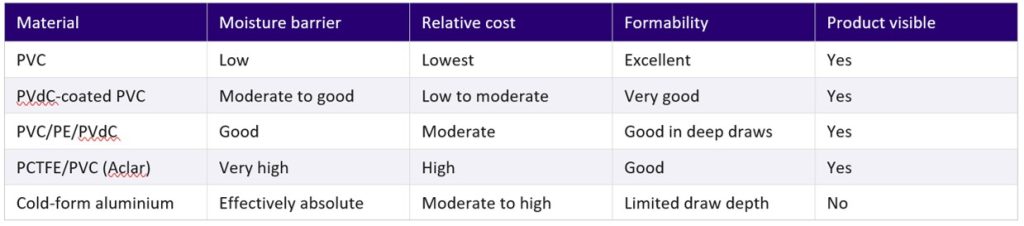
The main material options
PVC
Rigid PVC is the default forming film and the baseline against which everything else is priced. It forms easily at modest temperatures, gives excellent clarity, seals reliably to standard lacquered foil and is the cheapest option available. Its moisture barrier is modest. PVC suits products that are not moisture-sensitive, short shelf lives, and markets with temperate storage conditions.
PVdC-coated PVC
Coating PVC with polyvinylidene chloride raises the moisture and oxygen barrier substantially while keeping the base film's formability and transparency. Coating weights are specified in grams per square metre, and barrier improves with coating weight, so this is a tunable option rather than a single grade. It is the most common step up from plain PVC and covers a large share of moisture-sensitive solid dose products.
PVC/PE/PVdC laminates
A triplex construction bonds a polyethylene layer between the PVC and the PVdC. The polyethylene reduces the risk of coating cracks during deep forming, so the laminate holds its barrier in packs with deep or awkward pockets where a coated film would thin out. It is chosen where pocket geometry, not just barrier, is the constraint.
Aclar and other PCTFE laminates
Polychlorotrifluoroethylene, sold under the Aclar trade name, is laminated to PVC and gives the highest moisture barrier available in a transparent film. It is supplied in several gauges and barrier scales roughly with thickness, so you can specify to the stability requirement. Cost is the only real objection to it.
Cold-form aluminium (alu-alu)
A laminate of oriented polyamide, aluminium foil and PVC, cold-drawn rather than heat-formed. Because the pocket wall contains continuous aluminium, ingress is effectively zero and the pack is also opaque, which suits light-sensitive products. The trade-offs are real: the material does not stretch as far, so pockets are shallower and wider, the pack footprint grows, output speeds are lower than heat-forming, and the patient cannot see the dose.
Lidding foils and how the pack opens
Standard push-through lidding is hard-temper aluminium with a heat-seal lacquer matched to the forming film. The lacquer is not interchangeable: a lacquer formulated for PVC will not bond properly to a polyamide-faced cold-form laminate, and specifying the wrong one is a common cause of seal failures at qualification.
Peelable lidding uses a laminate that separates in layers when a tab is pulled, so the dose is lifted out rather than pushed through. It suits fragile or friable tablets and effervescent products.
Peel-push combines the two: the patient peels a paper or polyester layer away before pushing the dose through the remaining foil. This is the standard route to a child-resistant blister, because it requires two distinct actions.
Child-resistant packs are tested against recognised protocols using panels of young children and older adults, so senior-friendliness is part of the same test rather than a competing objective. Get this into the brief early, because it constrains both materials and tooling.
Calendarised, wallet and compliance formats
Where adherence matters, the blister itself becomes the dosing instruction. Calendarised packs print days of the week or sequential day numbers over each pocket. Wallet packs mount the blister in a printed card that folds around it, giving space for regimen information and, for many patients, a more durable pack in a pocket or handbag. Treatment-cycle packs run the exact course length, which reduces leftover doses.
These formats change secondary packing as much as primary. Registration between the printed calendar and the pocket layout has to be controlled, because a pack with the days one pocket out of register is a patient safety defect, not a cosmetic one.
What to look for in a medication blister packaging partner
Ask about these, in roughly this order.
Licences and release route. An MHRA Manufacturer's/Importer's Authorisation is the minimum for packing medicines, and a Wholesale Dealer's Authorisation matters if the same site will store and distribute. Ask how many Qualified Persons the site has and how many markets it releases to. Central Pharma holds an MIA and WDA(H), has three QPs and releases to more than 60 countries.
Material sourcing and vendor approval. The packer should be buying forming film and foil from audited, approved vendors, and should be able to tell you what changes when you move up a grade.
Line and format flexibility. Confirm the site can run the construction you need, including cold-form if that is where stability points, and that tooling for your pocket geometry is achievable.
Inspection. Fill verification, seal inspection and print verification should be automated, not sampled by eye. Central Pharma runs 100% AI inspection.
Export readiness. There is no mandatory domestic UK serialisation scheme, but EU FMD and US DSCSA still apply to product you export, so ask whether serialisation, anti-tamper device application and aggregation are done in-house.
Primary and secondary on one site. Blistering in one place and cartoning in another adds transport, storage, reconciliation and risk. Central Pharma does both on its Bedford site.
Key Takeaways:
- Specify the forming film against measured stability data, then buy the cheapest material that clears the requirement with margin.
- PVC, PVdC-coated PVC, PVC/PE/PVdC, PCTFE laminates and cold-form aluminium form a clear ladder of barrier and cost.
- Cold-form aluminium gives near-absolute barrier but costs draw depth, pack footprint, line speed and product visibility.
- Heat-seal lacquer must be matched to the forming film; mismatches surface as seal failures during qualification.
- Child-resistant and calendarised formats constrain tooling and secondary packing, so raise them at the briefing stage.
Talk to Central Pharma about your blister project
Central Pharma has been filling and packing for the pharmaceutical, medical device, cell and gene therapy and healthcare sectors since 2006. Blister packing runs alongside pot, liquid, pouch and sachet filling on our Bedford site, with cartoning, serialisation, aggregation, anti-tamper device application, 100% AI inspection and QP release in the same place. For practical input on material selection, format feasibility and route to market before you lock a specification, get in touch.
To stay informed on our latest thinking and technology developments, follow us on LinkedIn.
Contact Us Today View all news