
Pharmaceutical Sachet Filling: Formats, Fill Types and Regulatory Considerations
Thursday 27thAugust 2026 . Published by Central Pharma



A sachet looks like the simplest pack in pharmaceuticals: a rectangle of laminate with a powder inside. In practice, pharmaceutical sachet filling asks more questions of a formulation than most other primary formats, because the pack is formed, dosed and sealed in one continuous operation with no chance to inspect inside afterwards.
Get the laminate, the dosing method and the seal parameters right and you have a low-cost, high-barrier, single-dose pack. Get any of them wrong and you find out weeks later, when stability samples show moisture ingress or a batch fails fill weight. This guide covers the formats, how powders are dosed, what the laminate has to do, and the UK labelling constraints that come with a very small pack.
Sachet and stick pack formats
Four-side seal. The classic sachet, formed from two webs of laminate sealed on all four edges. It gives the flattest presentation, the most printable area and the most predictable seal, which is why it dominates for medicinal powders.
Three-side seal. A single web folded at the base and sealed on three edges. Less material, one less seal to validate, and a natural fold that can serve as a pouring gusset. Common for larger fills.
Stick pack. A narrow single-web pack with a back fin seal and two end seals. Popular for direct-to-mouth granules, effervescent doses and nutrition products because they open one-handed. The narrow web gives high output but a small printable panel, which becomes a regulatory constraint discussed below.
Pouch. A larger flexible pack, often with a gusset or stand-up base, sometimes with a zip or spout. Used for bulk powders, medical foods and multi-dose presentations. Central Pharma offers pouch filling alongside sachet powder filling.
The choice is rarely aesthetic. Dose size, pour behaviour, patient dexterity and printable area narrow the field quickly.
Fill types and dosing in pharmaceutical sachet filling
Central Pharma fills sachet powders, so powders and granules are the focus below.
Auger dosing
An auger screw turning a measured number of revolutions is the default for fine, cohesive, poorly flowing powders. Accuracy depends on consistent bulk density in the hopper, so level control, agitation and de-aeration all matter. Auger fillers are sensitive to powders that bridge or rathole and to any shift in particle size distribution between batches.
Volumetric cup dosing
Cups of fixed or adjustable volume meter the dose by displacement. Fast, simple and suited to free-flowing granules, effervescent granulations and crystalline salts. Because the dose is set by volume, drift in bulk density shows up directly as a fill weight shift, so bulk density has to be a controlled attribute of the incoming material.
Gravimetric dosing
The dose is weighed rather than measured by volume. Slower and more expensive, and the right answer where the active is potent, costly or carries a tight content uniformity requirement. Gravimetric systems correct for density variation in real time.
Flow characteristics and hygroscopicity
Angle of repose, compressibility, particle size distribution and moisture content determine whether a powder flows into a cup or clings to the funnel. Hygroscopic materials pick up ambient moisture during dosing, causing weight drift and caking. Room humidity control, short hopper residence time and a high-barrier laminate are the usual answers. Effervescent formulations are the extreme case: even modest moisture pickup starts the acid-carbonate reaction inside the pack.
Dust, containment and cross-contamination
Powder filling generates dust, and dust in the seal area is the most common cause of seal failure because it stops the laminate layers fusing cleanly. Machines use jaw wipers, extraction at the fill point and seal-area air knives. Dust also carries cross-contamination and operator exposure risk, so lines run under local exhaust ventilation with defined cleaning and changeover procedures, and potent compounds need documented containment.
Fill weight control and checkweighing
Fill weight is verified by periodic manual checks against a defined sampling plan and, commonly, by 100% in-line checkweighing that rejects out-of-tolerance packs automatically. Tolerances should come from the product specification and process capability, not the machine default. Reject verification, reject bin reconciliation and challenge testing at start-up form part of the GMP record.
Laminate structures, barrier and seal integrity
The laminate does four jobs: barrier, seal, strength and print surface.
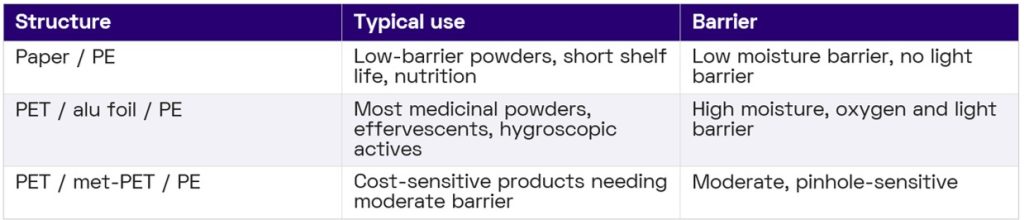
Foil laminates are the workhorse for medicinal powders because aluminium is a near-absolute moisture and light barrier. The outer PET carries the print and provides puncture resistance; the inner polyethylene is the sealant layer. Foil gauge matters, because thin foil flex-cracks at the fold and creates pinholes.
Seal integrity is verified by seal strength testing, visual inspection and dye penetration or leak testing. Seal parameters, temperature, pressure and dwell, are validated for each laminate and locked into the batch record.
Two details are worth specifying early. A tear notch or laser score gives a controlled opening point, which matters for elderly and arthritic patients who would otherwise tear across the powder. Where child resistance is needed, the sachet can be qualified to a child-resistant standard, which trades against ease of opening for the patient group.
Regulatory and labelling considerations
Sachets sit under the Human Medicines Regulations 2012, Part 13, which sets the statutory packaging, labelling and leaflet requirements. Two consequences follow for a small pack.
First, information must be printed directly onto the packaging. Over-labelling is not permitted for standard UK market packs, so the sachet artwork must be right at print, and version control on printed laminate reels is a controlled activity.
Second, the printable area is small. On a stick pack the panel will not carry everything, so statutory content is split between sachet and outer carton. As a working rule the sachet carries product name, strength, batch number, expiry date and the marketing authorisation holder, and the carton carries the full set including route of administration as a positive statement, storage conditions, warnings and the leaflet. MHRA best practice guidance on grouping critical information, minimum font size and avoiding colour-coding by strength alone applies to both artworks.
The product name in Braille is required on the outer carton of patient-use medicines, using Unified English Braille, and the leaflet must be available in accessible formats. Braille goes on the carton, not the sachet. UK market packs also carry "UK Only" labelling at a minimum of 7 point.
Applications spread beyond conventional medicines: effervescent analgesics, oral rehydration salts, powders for oral suspension, and clinical nutrition and medical foods, where the same technology runs under a different regulatory route.
Key takeaways
- Format choice is driven by dose size, pour behaviour and how much printable area the labelling regulations demand.
- Auger dosing suits cohesive powders, volumetric cups suit free-flowing granules, gravimetric dosing suits potent or high-value actives.
- Dust in the seal area is the leading cause of seal failure in pharmaceutical sachet filling, so extraction and jaw cleaning deserve as much attention as the dosing system.
- Foil laminates give the moisture and light barrier hygroscopic and effervescent products need; paper/PE structures do not.
- Under HMR 2012 Part 13 information must be printed directly on the pack, so statutory content is normally split between sachet and carton, with Braille on the carton only.
Talk to Central Pharma about sachet filling
Central Pharma has filled and packed for the pharmaceutical, medical device and healthcare sectors since 2006, from a 267,000 sq ft licensed site in Bedford. Sachet powder filling and pouch filling run alongside blister packing, pot filling and liquid filling, with cartoning, serialisation, inspection and QP release on the same site under an MHRA MIA and WDA(H). To discuss a pharmaceutical sachet filling project or a stick pack presentation, get in touch.
To stay informed on our latest thinking and technology developments, follow us on LinkedIn.
Contact Us Today View all news