
Bottle and Tub Filling for Pharma and Healthcare: What a Pharma Bottle Manufacturer Actually Does
Thursday 27thAugust 2026 . Published by Central Pharma



Search for a pharma bottle manufacturer and the results give you two entirely different kinds of supplier on the same page. One moulds empty containers from resin or glass and sells them by the pallet. The other holds a Manufacturer's / Importer's Authorisation and puts your product into those containers under GMP. Buyers brief the wrong one more often than you would expect.
The distinction is not pedantry. A container moulder is approved as a component supplier against a container specification. A contract filler is a licensed site whose filling, counting, sealing, labelling and batch release form part of the manufacturing chain behind your marketing authorisation. Brief one when you needed the other and the scope cannot be quoted properly.
This article sets out what bottle and tub filling actually involves: dosing technology, tablet counting, closures and torque, container material and the labelling controls that apply to UK market packs, so you can specify the work properly whichever supplier you approach first.
Pharma bottle manufacturer or contract filler?
A bottle manufacturer moulds the empty container: HDPE blow-moulded from resin, PET from injection-moulded preforms, glass from a furnace. Its output is a qualified component, not a medicine.
Most buyers need the contract filler and packer: somebody licensed to put product into the bottle or tub, close it, seal it, label it, carton it and release it to market. Central Pharma sits in the second category. It does not mould bottles. It fills them, at its licensed Bedford site, under GMP.
Liquid filling
Liquid filling covers oral solutions and suspensions, syrups, topical lotions, gels, sanitisers and mouthwashes. Dosing technology is chosen from the product's rheology.
Piston fillers displace a fixed volume with a plunger. Accurate, tolerant of viscous and particulate-bearing products, and the usual choice for creams, gels and thick suspensions. Changeover means stripping and cleaning the piston and valve assembly.
Peristaltic fillers squeeze a flexible tube, so product only contacts the tubing. Suited to small batches, high cross-contamination risk or single-use fluid paths. Accuracy depends on tube condition, which degrades with running hours.
Flowmeter fillers meter by mass or volume as product passes a sensor. Fast, no product-contact moving parts, well suited to low-viscosity aqueous liquids. Less suitable where the product entrains air.
Three product properties dominate. Viscosity sets nozzle size, fill speed and whether the product drips or strings after the valve closes. Foaming is the enemy of aqueous surfactant-bearing products, managed with bottom-up diving nozzles that fill beneath the liquid surface, reduced fill velocity and a settling delay before capping. Fill volume accuracy is verified in-process by periodic weight checks converted using product density, and often by 100% checkweighing.
Pot, tub and bottle filling for solid dose
Tablets and capsules go into pots, tubs and bottles by counting, not by weight, and the counting method is a real specification decision.
Slat counters use a rotating slotted slat sized to the tablet. Fast, mechanically reliable and well proven, but each product needs its own slat set and changeover is a real operation. Slats can chip friable tablets.
Vision counters pass tablets through an optical channel and count electronically. Changeover is a recipe change rather than a tooling change, which suits shorter runs, varied portfolios, irregular shapes and capsules. They need clean optics and careful qualification against split tablets and dust.
Count accuracy is verified at start-up, at intervals and at end of run, and reconciled against the batch. Underfill is a patient-supply issue; overfill is a cost and, for controlled drugs, a compliance issue.
Two inserts are common. Desiccant canisters or sachets control headspace moisture for moisture-sensitive tablets, inserted before closure with a presence check. Cotton or rayon coil limits tablet movement in transit. Both add a component to reconcile and a detection step to the line.
Closures, sealing and torque
The closure is where most bottle failures originate.
Induction sealing bonds a foil laminate liner to the bottle land by heating it with an induction coil after capping, giving a tamper-evident, leak-resistant, moisture-barrier seal. Quality depends on land flatness, cap torque, coil power and line speed, so each combination is qualified and monitored with peel or burst testing on samples.
Torque control is a critical process parameter, not a setting adjusted by feel. Too low and the closure loosens in transit. Too high and the liner is crushed, the cap distorts or a child-resistant mechanism binds. Application torque is set and verified, and removal torque checked on retained samples after thermal cycling.
Tamper-evident bands and shrink sleeves are the alternative where induction sealing does not suit the container or liner system.
Child-resistant closures are required for many liquid medicines and certain solid dose products. Push-and-turn and squeeze-and-turn systems are qualified as a closure and container system, because child resistance is a property of the pairing, not the cap alone. Senior-friendly opening is part of the same standard, so closures are tested rather than assumed.
Container material and its consequences
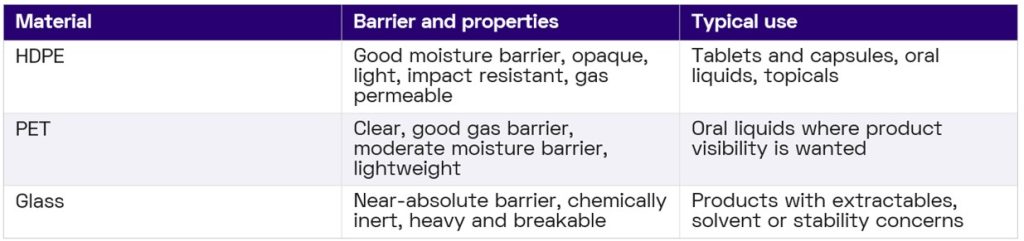
Material choice drives stability, not just appearance. HDPE lets moisture and oxygen through slowly, which is why moisture-sensitive tablets in HDPE usually need a desiccant. Glass is inert but adds weight, freight cost and breakage risk. Extractables and leachables assessment is the marketing authorisation holder's responsibility, but the filler needs the outcome, because it dictates headspace control, nitrogen purge if required, and the liner specified for the closure.
Labelling, over-labelling and in-process control
For standard UK market packs, statutory information must be printed directly onto the packaging. Over-labelling is not permitted, so bottle labels are printed to the approved artwork under version control. Over-labelling is used in defined circumstances such as export markets and rework, under controls covering obliteration of superseded text, no obscuring of statutory information, and reconciliation.
The product name in Braille is required on the outer carton of patient-use medicines, in Unified English Braille. UK market packs carry "UK Only" labelling at a minimum of 7 point, and since 1 January 2025 joint EU/UK packs are not permitted.
In-process checks through a filling run typically cover fill volume or count, torque, seal integrity, label presence and position, print legibility, code and expiry verification, and reject reconciliation. Product-contact parts are cleaned to a validated procedure with defined acceptance criteria, and line clearance between batches is signed off before the next run. Cleaning validation and changeover discipline are what make shared equipment acceptable to an auditor.
Key takeaways
- A pharma bottle manufacturer moulds empty containers; a contract filler holds the MIA and fills, closes, labels and releases them. Most buyers need the second.
- Liquid dosing technology follows the product: piston for viscous, peristaltic for small or contamination-sensitive batches, flowmeter for low-viscosity aqueous liquids.
- Slat counters favour long runs; vision counters favour varied portfolios and short runs.
- Torque and induction seal parameters are qualified process parameters, and child resistance is a property of the container and closure pairing.
- HDPE, PET and glass differ materially in moisture and gas barrier, which affects desiccant use, headspace control and liner specification.
Talk to Central Pharma about bottle and tub filling
Central Pharma is a contract filler and packer, not a bottle moulder. Since 2006 it has filled and packed for the pharmaceutical, medical device, cell and gene therapy and healthcare sectors from a 267,000 sq ft licensed site in Bedford, offering pot filling and liquid filling alongside blister, sachet and pouch filling, with cartoning, labelling, serialisation, inspection, temperature-controlled storage and QP release on the same site. It holds an MHRA MIA and WDA(H), ISO 9001 and ISO 13485, and QP releases product to more than 60 countries. If you came looking for a pharma bottle manufacturer and need a licensed partner to fill and pack, get in touch.
To stay informed on our latest thinking and technology developments, follow us on LinkedIn.
Contact Us Today View all news