
Controlled Drug Storage in the UK: Licences, Vaults and Compliance
Tuesday 8thSeptember 2026 . Published by Central Pharma



Most companies discover the difficulty of controlled drug storage late, usually when a product moves from clinical supply into commercial volumes and somebody asks where the stock will sit. The answer is not a lockable cupboard in the corner of a warehouse.
Controlled drugs sit under a separate legal regime from the rest of your inventory. The Misuse of Drugs Act 1971 and its regulations create criminal offences around possession and supply, the Home Office licenses the activity and inspects the site, and the physical security of the store is specified in law rather than left to judgement. None of that displaces Good Distribution Practice. It sits on top of it.
The legal framework
The Misuse of Drugs Act 1971 is the primary legislation. It defines controlled drugs and makes their production, supply and possession unlawful except as permitted by regulations made under it.
Those regulations are the Misuse of Drugs Regulations 2001, which create the exemptions allowing legitimate pharmaceutical activity. They place each drug into one of five schedules, and the schedule determines almost everything that follows: whether you need a licence, how the drug is stored, what records you keep and how it may be destroyed.
Physical security comes from a third instrument, the Misuse of Drugs (Safe Custody) Regulations 1973, which sets construction standards for the safes, cabinets and rooms in which the higher schedules must be kept.
Schedules 1 to 5 and what they mean
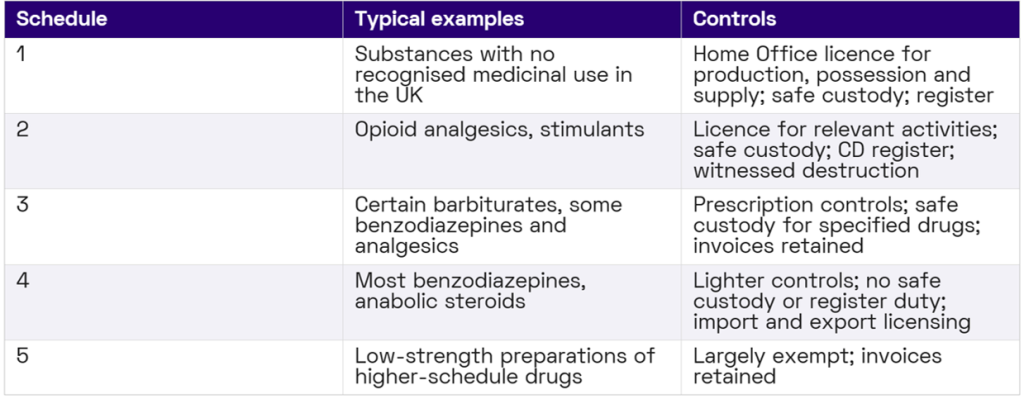
The burden is not uniform. Schedule 2 is where most commercial pharmaceutical activity concentrates and the full weight of the regime applies. Schedules 4 and 5 carry real obligations, particularly around import, export and record retention, but do not require a safe. If you hold across the range, your quality system has to apply the right rules product by product rather than one blanket procedure. Central Pharma holds a UK Home Office licence for the control of Schedule 1 to 5 narcotics and offers Schedule 1 to 5 storage and supply from Bedford.
Home Office licensing
A Home Office licence is required for the production, possession and supply of Schedule 1 substances, and for certain activities involving Schedules 2 to 4. Import and export are licensed separately, usually per consignment.
The licence is granted to a named company at a named site for named activities. It is not transferable, and it does not cover a second warehouse just because the same business runs both. Applications require details of the premises and security, plus named individuals subject to police checks. The Home Office compliance team inspects the site, and licences run for a fixed term and must be renewed, with renewal treated as a fresh assessment rather than a formality.
Changes matter. Altering the store, moving stock to another building, changing the responsible individuals or adding activities all need to be notified. Doing the work first and telling the Home Office afterwards is the fastest route to trouble at renewal.
Safe custody: what the store has to be
The Safe Custody Regulations 1973 require relevant drugs to be kept in a locked safe, cabinet or room constructed and maintained so as to prevent unauthorised access. The schedules to those regulations set construction specifications covering the material and thickness of the body and door, the hinges, the lock and how the unit is fixed to the building.
For volume, a cabinet is not the answer. Commercial controlled drug storage generally means a purpose-built secure room or vault within the warehouse, with a construction specification for walls, ceiling and floor, a certified door set, and logged access limited to a few authorised people.
Home Office security guidance for licensed firms goes beyond the minimum construction standard. Expect to demonstrate an intruder alarm monitored by an alarm receiving centre with an agreed response, CCTV covering the store and its approaches with defined image retention, access control using individual credentials rather than shared keys, and separation of the store from general warehouse traffic. Security is assessed as a system, so a strong vault reached through a poorly controlled corridor will still be challenged.
Records, registers and reconciliation
Schedule 1 and Schedule 2 drugs must be recorded in a controlled drugs register. Entries record receipts and supplies chronologically, with a running balance, in a form that cannot be altered without the correction being visible. Registers are kept for two years from the last entry, and invoices for Schedule 3 and 5 transactions are retained on the same basis.
Physical reconciliation is what turns the register into a control. Balances are checked against stock at a defined frequency, discrepancies are investigated rather than adjusted, and the outcome is documented. An unexplained discrepancy is reportable, and how a company handles the first small loss tends to shape how the regulator views everything else.
Destruction
Controlled drugs cannot simply be sent for waste disposal. Destruction of Schedule 1 and Schedule 2 stock must be carried out in the presence of a person authorised by the Secretary of State, typically a Home Office compliance inspector, and recorded with the drug, quantity, date, method and the names of those present. The witness must see the drug rendered irretrievable, not merely handed over.
Transport and safe custody in transit
The obligation does not end at the loading bay. Controlled drugs in transit remain subject to safe custody, so they travel in locked containers or compartments, vehicles are not left unattended with stock aboard, drivers are vetted and trained, and custody is documented at every handover. Deliveries go to named, verified recipients against a valid requisition or order.
How this sits alongside GDP and the WDA(H)
A Home Office licence permits you to handle the drugs. It does not authorise wholesale dealing in medicines. That comes from the Wholesale Dealer's Authorisation, WDA(H), issued by the MHRA, under which GDP 2013/C 343/01 applies in full: a quality system, a Responsible Person, qualified suppliers and customers, temperature control, returns and recall procedures, self-inspection.
The two regimes overlap but are not the same, and different bodies inspect them against different rules. Your procedures have to satisfy both at once, so the CD register and the GDP stock record must agree, the RP and the Home Office named contacts must both have visibility, and security controls must not obstruct the traceability GDP demands.
Key takeaways
- A Home Office licence does not replace a WDA(H), and GDP applies to controlled drugs in full
- The schedule a drug sits in determines the licence, storage standard, records and destruction route
- A Home Office licence is site and activity specific, needs police-checked named individuals, and is renewed on fresh assessment
- Safe custody sets legal construction standards; commercial volumes generally need a purpose-built secure room, not a cabinet
- CD registers must be reconciled against physical stock, with discrepancies investigated rather than adjusted away.
Talk to Central Pharma about controlled drug storage
Central Pharma holds a UK Home Office licence covering the control of Schedule 1 to 5 narcotics, alongside an MHRA WDA(H) and MIA, and offers Schedule 1 to 5 controlled drug storage and supply from its 267,000 sq ft Bedford site, within the same quality system as our ambient, +2°C to +8°C and −20°C storage, packing and QP release. To discuss holding controlled stock under licence, get in touch.
To stay informed on our latest thinking and technology developments, follow us on LinkedIn.
Contact Us Today View all news