
GDP Compliance for Pharma Warehousing: What It Means for Your Supply Chain
Wednesday 9thSeptember 2026 . Published by Central Pharma



If you own a medicinal product supply chain, GDP is the standard your pharma warehousing is held to from the moment a batch is certified until it reaches your customer. It is also the standard the MHRA will inspect that warehouse against, whether it is yours or somebody else's.
The document itself is short. The EU Guidelines on Good Distribution Practice of medicinal products for human use, 2013/C 343/01, retained in UK law and enforced through the Wholesale Dealer's Authorisation, WDA(H), runs to ten chapters. What follows is a practical walk through them from the point of view of someone accountable for the stock, with the supply chain consequence of getting each one wrong.
Two related articles cover adjacent ground: what a specialist pharmaceutical warehouse looks like physically, and the difference between GMP and GDP. This one deals with the compliance obligations themselves.
Quality management and documentation
GDP opens with the requirement for a documented quality system covering the organisation, its procedures and its responsibilities, including change control, deviations, CAPA and management review. Quality risk management runs through it.
Documentation is treated as evidence. Procedures must be current, approved, version controlled and actually followed. Records must be made at the time of the activity, be legible and traceable, and be retained for the required period.
The failure mode is familiar: a procedure written three years ago that describes a process nobody follows any more. Inspectors find it by comparing the SOP with what the operator does. The consequence is a finding that questions the whole system, because if one procedure is not controlled the inspector has no reason to trust the rest.
Personnel and the Responsible Person
Every WDA(H) names a Responsible Person. The RP is a legally recognised role with defined duties: ensuring the quality system is implemented and maintained, that only authorised suppliers and customers are used, that returns and recalls are handled properly, and that products are released to sale only when compliant.
The RP needs the authority to stop a shipment and the resources to do the job. An RP in name only, overruled by commercial pressure or unable to see the transactions, is one of the more serious findings the MHRA can make, because it undermines every other control.
Staff also need role-specific training, records to prove it, and refresher training when procedures change.
Premises and equipment in pharma warehousing
Storage areas must be secure, clean, suitable for purpose, and qualified for the conditions they claim to hold. That means temperature mapping in summer and winter, continuous monitoring with calibrated equipment, defined and segregated areas for quarantine, returns, rejects and recalled stock, and pest control.
Consequences here are direct. Unmapped storage means you cannot prove the product was held correctly, and a batch you cannot evidence is a batch you may not be able to sell. Cold chain qualification and monitoring is covered in detail in our article on pharmaceutical cold storage. Central Pharma operates over 10,000 pallet locations at Bedford, covering ambient, +2°C to +8°C refrigerated and −20°C frozen storage under an MHRA WDA(H).
Operations: suppliers, customers, receipt, storage and supply
This is the operational core of GDP and where most pharma warehousing exposure sits.
You must qualify your suppliers, confirming they hold the appropriate authorisation and that the product comes from a legitimate source, and qualify your customers, confirming they are entitled to receive the product. Buying from an unverified trader or supplying someone without a valid licence are both offences in substance as well as findings on paper.
On receipt, deliveries are checked against the order and the documentation, examined for damage or tampering, and quarantined until released into saleable stock. Storage requires stock rotation, usually FEFO, with expiry management and segregation of anything not fit for sale. Picking and supply must be traceable, so that for any batch you can identify every customer who received it and when. That single capability is what makes a recall executable in hours instead of days.
Complaints, returns, falsified medicines and recalls
Complaints must be recorded, categorised as product quality or distribution related, investigated and closed out, with quality complaints passed to the marketing authorisation holder.
Returned goods go back into saleable stock only when defined conditions are met: the product was stored correctly throughout, the packaging is intact, the return is within an acceptable period, and the assessment is documented and approved by the RP. Cold chain returns without continuous temperature evidence do not qualify.
Suspected falsified product must be segregated immediately, must not re-enter the supply chain, and must be reported to the MHRA and the marketing authorisation holder.
Recall procedures must be written, tested and capable of running out of hours. An untested recall procedure is discovered to be inadequate at the worst possible moment, and a recall that cannot be executed quickly turns a batch problem into a regulatory and reputational one.
Outsourced activities and the written contract
Chapter 7 is the one supply chain owners most often underestimate. If you outsource storage or distribution, you remain the contract giver, responsible for assessing the competence of the contract acceptor and for monitoring their performance. Outsourcing the activity does not outsource the accountability.
A written contract is mandatory and must be specific. It should define the scope of work, which party holds which authorisation, storage conditions and monitoring arrangements, deviation and excursion notification with timescales, who makes the disposition decision on affected stock, returns and recall responsibilities, the right to audit, subcontracting controls, data ownership and record retention, and termination and stock transfer arrangements. Vague technical agreements are where disputes start.
Self-inspection and transportation
Self-inspection is a planned programme of internal audits covering all GDP areas, with findings, corrective actions and follow-up recorded. A self-inspection programme that never raises a finding is not credible.
Transportation extends the warehouse controls to the road. Vehicles and shipping systems must maintain the required conditions, routes and transit times must be justified, deliveries must reach the correct verified recipient, and the whole thing must be documented. Central Pharma distributes through in-house electric vehicles and approved transport vendors.
Your own WDA(H) or your partner's
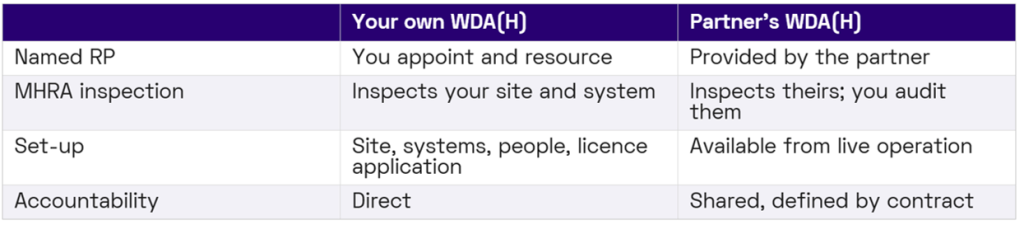
Using a partner's authorisation is legitimate and common. It does not make you a bystander. You are still expected to qualify the provider, audit them, and hold a technical agreement that says who does what. The MHRA will ask you to show that assessment.
Key takeaways
- GDP applies from batch certification to delivery, and is enforced through the WDA(H).
- The Responsible Person needs real authority; an RP who cannot stop a shipment is a serious finding.
- Qualification of suppliers and customers, and full batch traceability to customer, are the operational heart of GDP.
- Outsourcing storage does not outsource accountability, and the written contract has to be specific.
- Returns, falsified medicines and recall handling are where poor systems become public problems.
Talk to Central Pharma about GDP-compliant warehousing
Central Pharma, established in 2006, holds pharmaceutical stock under an MHRA WDA(H), with more than 10,000 pallet locations across ambient, refrigerated and frozen storage on its 267,000 sq ft Bedford site, Schedule 1 to 5 controlled drug storage, an integrated quality management system, a dedicated QA team and three Qualified Persons. If you are assessing whether your current pharma warehousing arrangement would stand up to inspection, talk to us.
To stay informed on our latest thinking and technology developments, follow us on LinkedIn.
Contact Us Today View all news