
MHRA Licensing for Pharmaceutical Contract Packaging Services
Monday 21stSeptember 2026 . Published by Central Pharma



Most buyers assess a contract packer on capability: line speeds, formats, capacity, price. The licence position gets a tick in a questionnaire. That is the wrong way round. The licence decides what a site is legally allowed to do with your product, and no amount of equipment compensates for an activity that is not on it.
Pharmaceutical contract packaging services in the UK sit under a stack of authorisations issued by different bodies. The MHRA covers manufacture, importation, wholesale distribution and active substance storage. The Home Office covers controlled drugs. The FDA covers product destined for the United States. Each has its own scope, its own named people and its own inspection regime.
This article sets out which licences a contract packer needs, how licensing and inspection work, and what you should ask to see before you place a batch.
The licences a contract packer must hold
Manufacturer's / Importer's Authorisation (MIA)
The MIA is the core licence. It authorises manufacture, which in packing terms covers primary filling and secondary packing, and importation of finished medicinal products from outside the UK. It names the site, the permitted activities, the dosage forms and the Qualified Persons who may certify batches.
Scope is specific. An MIA authorising secondary packing of solid oral dose does not authorise liquid filling, and one authorising manufacture does not automatically authorise importation. Read the activities listed, not the fact that a licence exists.
Wholesale Dealer's Authorisation, Human, WDA(H)
The MIA covers the site up to the point of QP certification. Everything after that, storage of released product, order picking and onward supply, falls under Good Distribution Practice and requires a WDA(H). GDP in the UK follows the retained EU guidelines 2013/C 343/01 and requires a named Responsible Person, qualified and mapped storage, continuous temperature monitoring, qualification of suppliers and customers, and controls on returns, falsified medicines and recalls.
A packer that also stores and distributes needs both. Central Pharma holds MIA and WDA(H), which is what allows packing, certification, storage and despatch to happen in one place rather than across three sites.
API storage licence
Storing active pharmaceutical ingredient is a separate registered activity from handling finished product. If your programme involves holding API on site ahead of filling, check the site is registered for it. Central Pharma holds one.
Home Office controlled drug licence
Controlled drugs are governed by the Misuse of Drugs Act 1971 and the Misuse of Drugs Regulations 2001, which classify substances into Schedules 1 to 5. A Home Office licence is required for production, possession and supply of Schedule 1 and for certain activities in Schedules 2 to 4. Safe custody obligations under the Misuse of Drugs (Safe Custody) Regulations 1973 bring approved safes, cabinets or rooms, controlled access, CD register record-keeping and witnessed destruction, with Home Office guidance on alarms, CCTV and access control. Central Pharma is licensed for Schedule 1 to 5.
FDA registration
Product going to the United States adds a second regulator. A UK site packing and labelling for the US market registers as a drug establishment with the FDA, lists the operations it performs, and becomes liable to FDA inspection in its own right. Central Pharma is FDA registered for secondary packing and labelling.
Application, site master file and named personnel
Applications are made through the MHRA's process licensing portal, with fees payable and defined supporting documentation. The centrepiece is the site master file, a controlled document describing the site: activities, buildings, utilities, equipment, quality system, personnel, documentation controls, contract activities and self-inspection programme. Inspectors read it before they arrive and test what it claims once they are there.
The application also names individuals. An MIA names the Qualified Persons, the Production Manager and the Quality Control Manager; a WDA(H) names the Responsible Person. Each is assessed for qualifications, experience and suitability, and changes are notified through variations. Those names are not administrative detail. They are the roles the regulator will hold to account.
Pre-authorisation inspection and the inspection cycle
A new licence is granted after a pre-authorisation inspection. The inspector examines the site against GMP, walks the flows, reviews the quality system and tests whether the site master file matches reality. A site cannot operate the licensed activity before grant, so this inspection sits on the critical path of any new facility or activity.
After that, inspection is risk-based: frequency follows compliance history, product risk, operational complexity and the outcome of previous inspections. Inspections may be announced or unannounced, and can be triggered by a specific concern rather than by the calendar.
How deficiencies are classified
Findings are graded, and the grade drives what follows.
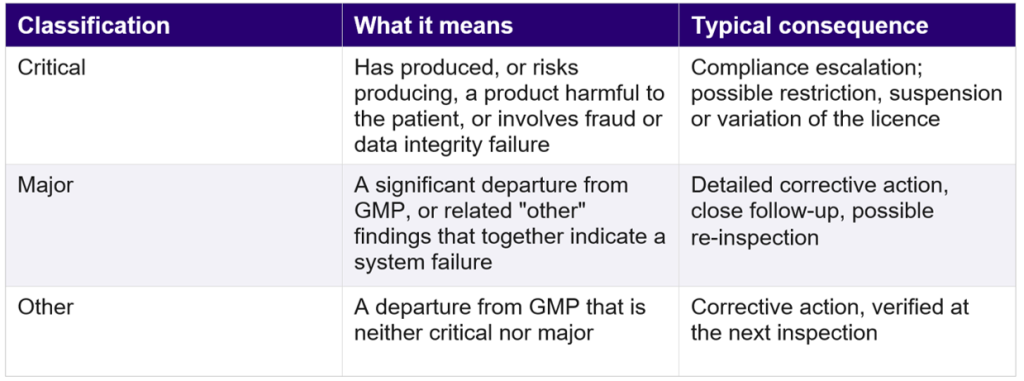
Serious or persistent non-compliance is referred into the MHRA's compliance escalation process, which can result in conditions on the licence, suspension of activities or a statement of non-compliance with GMP. Those statements, and the certificates issued after satisfactory inspections, are published in the MHRA's public GMP and GDP database, so a site's compliance position is not something a supplier can conceal.
CAPA and response timelines
After the inspection the site receives a report listing the deficiencies. The expected response is a corrective and preventive action plan, normally submitted within around 30 days, with each finding addressed individually: root cause, correction, preventive action, owner and completion date. Critical findings usually need immediate containment reported ahead of the full plan. Regulators judge CAPA quality as much as speed. A response that fixes the instance without addressing why the system allowed it invites a repeat finding, and repeat findings turn a manageable inspection into escalation.
Assessing pharmaceutical contract packaging services: what to ask for
Three documents tell you more than any capability presentation.
The licence itself. Not a statement that one exists. The actual authorisation, showing the exact activities and dosage forms, the site address and the named personnel. Check that what you need done appears on it.
The last inspection date and outcome. When was the site last inspected, what was found, how were findings classified, is the CAPA closed. A site with nothing to hide answers readily.
The technical agreement. The document allocating GMP responsibility between you and the packer: who does what, who approves what, who certifies, who investigates deviations and who holds retained samples. Any serious provider will have a template and will expect the discussion.
Key takeaways
- Deficiencies are graded critical, major or other, findings and non-compliance statements are published, and CAPA quality determines whether an issue escalates.
- The MIA authorises manufacture, packing and importation and names the QPs; read the specific activities and dosage forms rather than assuming coverage.
- Storage and distribution after QP certification fall under GDP and need a separate WDA(H) with a named Responsible Person.
- API storage, Schedule 1 to 5 controlled drugs and US-bound product each require their own additional authorisation or registration.
- Licensing runs through the MHRA portal on the strength of a site master file and named personnel, then a pre-authorisation inspection and a risk-based cycle.
- Deficiencies are graded critical, major or other, findings and non-compliance statements are published, and CAPA quality determines whether an issue escalates.
Talk to Central Pharma about licensed packing
Central Pharma holds an MHRA MIA, an MHRA WDA(H), an MHRA API storage licence, FDA registration for secondary packing and labelling, and a UK Home Office licence covering Schedule 1 to 5, all operated from a single 267,000 sq ft Bedford site with three Qualified Persons and a quality management system certified to ISO 9001 and ISO 13485. If you are evaluating pharmaceutical contract packaging services and want to see the licences, the inspection history and the technical agreement before you commit, get in touch.
To stay informed on our latest thinking and technology developments, follow us on LinkedIn.
Contact Us Today View all news