
FDA Registration for UK Pharmaceutical Packaging Suppliers
Tuesday 22ndSeptember 2026 . Published by Central Pharma



A marketing authorisation holder with a US product and a European packing site runs into a question MHRA licensing cannot answer: is the site registered with the FDA? Not audited, not accredited. Registered. Without it, product packed at that site cannot lawfully be offered for import into the United States.
This is one of the clearest dividing lines between pharmaceutical packaging suppliers in the UK. The obligation is simple to describe and demanding to hold, because registration invites inspection.
Establishment registration and drug listing
Two obligations sit under section 510 of the Federal Food, Drug, and Cosmetic Act, implemented in 21 CFR Part 207. Establishment registration identifies the facility: who it is, where it is and what it does, which for a contract packer is typically repacking, relabelling and packaging of finished dosage forms. Drug listing identifies the products handled there, each with its own record.
Foreign establishments must register before product is offered for import. Registration is not an endorsement, and FDA is explicit that no site may imply approval. It puts the facility on the record and creates a standing obligation to be inspectable.
The US agent and the facility identifier
Every foreign establishment must name a US agent with a physical place of business in the United States. The agent is the communications route: FDA correspondence, product questions and help scheduling inspections pass through them. Each establishment names one agent, who must confirm the appointment.
Registration also requires a unique facility identifier, and FDA has designated the DUNS number. It must resolve to the physical site, not the corporate headquarters. A mismatch between the DUNS record, the registered address and the address on an import entry is enough to hold a shipment.
Annual renewal
Registration is not permanent. It must be renewed each year between 1 October and 31 December, and listing data reviewed and certified on the published schedule. Miss the renewal and product from that site is liable to refusal at the border with no grace period.
NDC labeler codes
Drug listing generates the National Drug Code structure. FDA assigns the labeler code; the labeler assigns the product and package codes. The labeler is whoever appears on the label as manufacturer, packer or distributor, usually the customer in a contract packing arrangement. Where a packer relabels under its own code it becomes the labeler, with the obligations that follow. Settle this in the technical agreement.
cGMP under 21 CFR 210 and 211
US current good manufacturing practice for finished pharmaceuticals sits in 21 CFR Parts 210 and 211. The intent overlaps heavily with EU GMP, but the expression differs.
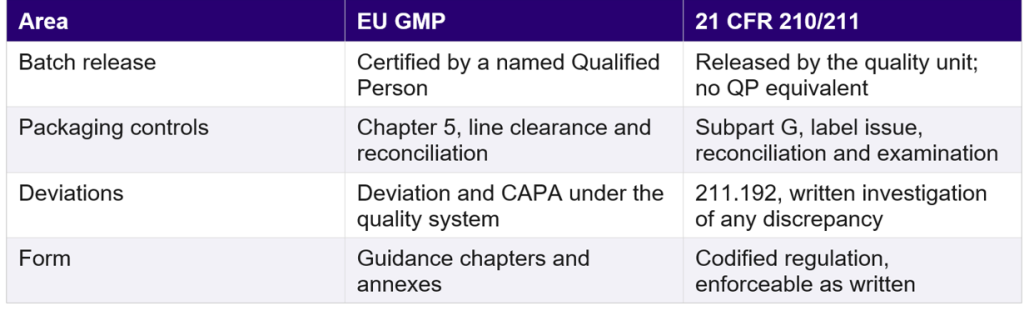
Subpart G is what a labelling and packing site is examined against most closely. It covers issue and reconciliation of labelling, examination of printed components, restrictions around gang-printed labelling, and when electronic verification substitutes for other controls. In an inspection that means reconciliation arithmetic, line clearance records, vision challenge tests and handling of rejected printed material.
The mutual recognition arrangement under which FDA and European regulators rely on each other's GMP inspection outcomes for certain human medicinal products applies to EU member state authorities. It does not extend to UK sites following EU exit. A UK packing site should therefore plan on the basis that FDA may inspect it directly. In any case, recognition arrangements remove none of the establishment registration, drug listing or US agent obligations, which apply regardless.
Inspection, detention and import alert
FDA inspects foreign establishments, generally with advance notice, classifying the outcome as no action indicated, voluntary action indicated, or official action indicated. Observations are issued on Form FDA 483 at close-out, and a response within 15 working days is expected if it is to count before further action is decided. An official action classification can escalate to a warning letter, published on FDA's website and permanent. For a contract packer that publication is the real commercial exposure, because every customer's due diligence will find it.
Routine enforcement happens at the border. Entries are filed electronically with US Customs and screened by FDA, which can detain a shipment and issue a notice of action. Where FDA has evidence of a compliance problem it can place a site or product on import alert, triggering detention without physical examination, and the burden shifts to the importer to prove compliance for every consignment. In supply terms it is a stop. Most avoidable detentions come from data rather than quality: a wrong registration number on the entry line, a DUNS that does not match, an unlisted product, a lapsed registration.
US labelling and DSCSA
A US pack is not an over-labelled EU pack. Requirements under 21 CFR Part 201 include the NDC, the "Rx only" statement for prescription products, established name and quantity, net contents, the name and place of business of the manufacturer, packer or distributor, and a linear barcode carrying the NDC on most prescription labels. Over-the-counter product needs the Drug Facts format. In practice, a distinct US carton with its own artwork version control.
The Drug Supply Chain Security Act adds serialisation. The product identifier is a GS1 2D DataMatrix encoding four application identifiers: (01) 14-digit GTIN, (17) expiry as YYMMDD, (10) lot and (21) serial number, printed at around 5 x 5 mm minimum and typically expected to grade B or better under ISO 15415. The stabilisation period ended on 27 May 2026. From 28 May 2026, aggregation and interoperable EPCIS 1.2 or later exchange became enforceable, so every case must report the unit serials it contains and every pallet the case serials it carries.
Why registration separates pharmaceutical packaging suppliers
Registration is an obligation a site chooses to take on and then maintain year after year, so a buyer should confirm it explicitly rather than assume it. For a customer with a UK or EU supply base and a US market, an unregistered packer forces a second site, a second technical agreement, an extra transport leg and a second qualification exercise. A registered site lets one building serve UK Only packs, EU FMD packs and DSCSA packs under one quality system. Central Pharma is FDA registered for secondary packing and labelling of pharmaceuticals.
Key takeaways
- Establishment registration and drug listing are separate obligations, and pharmaceutical packaging suppliers need both before product can be offered for import into the US.
- A foreign establishment must name a US agent, supply a DUNS matching the physical site, and renew registration between 1 October and 31 December each year.
- 21 CFR 210/211 overlaps with EU GMP but is codified regulation, and Subpart G labelling controls are what a packing site is examined against most closely.
- Import alert brings detention without physical examination, so registration data accuracy matters as much as quality performance.
- DSCSA requires a GS1 DataMatrix product identifier, and since 28 May 2026 aggregation and EPCIS exchange have been enforceable across trading partners.
Talk to Central Pharma about US-bound packing
Buyers assessing pharmaceutical packaging suppliers for a US route should start with the registration itself. Central Pharma has packed and labelled for the pharmaceutical, medical device, cell and gene therapy and healthcare sectors since 2006, from a 267,000 sq ft licensed site in Bedford. The site is FDA registered for secondary packing and labelling of pharmaceuticals and holds an MHRA MIA and WDA(H), with three Qualified Persons and product QP released to more than 60 countries. Serialisation, aggregation and reworking data management run in-house across global directives. To discuss US supply, get in touch.
To stay informed on our latest thinking and technology developments, follow us on LinkedIn.
Contact Us Today View all news