
Aggregation vs Serialisation in Pharma: What Is the Difference?
Tuesday 22ndSeptember 2026 . Published by Central Pharma



The two terms get used interchangeably in tender documents, and should not be. In serialisation pharma projects, mixing them up creates scope gaps that surface when a customer's first US shipment is rejected for missing case data.
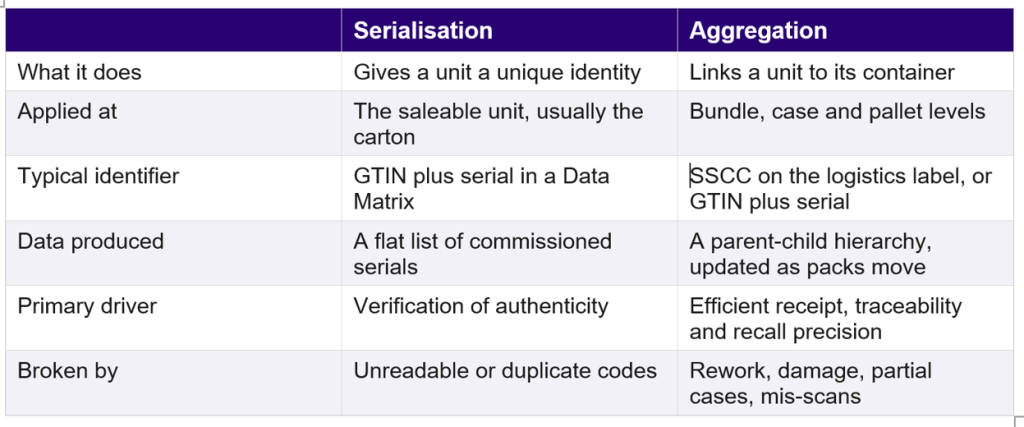
Serialisation is about identity. Aggregation is about relationship. A site can serialise without aggregating. It cannot aggregate without serialising first.
The precise definitions
Serialisation assigns a unique identifier to an individual saleable unit: in practice a GS1 2D DataMatrix on the carton encoding product code, expiry, lot and a serial number belonging to that carton alone. The output is a list of live serial numbers, each tied to a product, batch and expiry.
Aggregation records the parent-child relationship between containers. It captures which unit serials sit inside which case, and which case identifiers sit on which pallet. The output is not a list, it is a tree. Every child has one parent at any moment, and every parent knows its children.
They answer different questions. Serialisation answers "is this pack genuine?". Aggregation answers "where is this pack, without opening the box?".
The packaging hierarchy
Most supply chains use four levels, although not every product uses all of them.
The levels run item, bundle, case, pallet. The item is the saleable unit and carries the serialised DataMatrix. A bundle is an intermediate grouping, for example ten cartons shrink-wrapped together. The case is the shipping carton, labelled with a Serial Shipping Container Code or equivalent, and the pallet carries its own SSCC. Aggregation links each level to the one above, and breaking any link makes the chain below it invisible to a receiving system.
How aggregation is captured on the line
Three approaches are common, and the choice depends on volume, pack format and tolerance for manual intervention.
Manual scanning. An operator scans each unit into an open case, then scans the case label to close it. Slow but flexible, and often right for low volumes, clinical supply or complex kits.
Tunnel or multi-head vision scanning. Cameras around the case read every unit code as it passes. Fast, and dependent on pack presentation being consistent enough for every code to be visible.
Weight verification. Checkweighing confirms the case holds the expected number of units. It does not identify which units, so it supports aggregation rather than replacing it.
Whatever the method, the control point is the same: no case is closed and labelled until the system confirms the expected count of valid, unique child codes. Central Pharma runs full aggregation in-house alongside serialisation and anti-tamper application.
Why aggregation matters
The commercial argument is inference. A wholesaler receiving a pallet scans one SSCC and, using aggregation data supplied by the manufacturer, infers every case and every unit serial on it. No opening cases, no scanning thousands of cartons at goods-in. Receipt takes minutes instead of hours. Without aggregation the receiving site either scans every unit, unrealistic at wholesale volumes, or accepts the delivery unverified, which defeats the point of serialising.
Recall precision is the second argument. With a full hierarchy, a manufacturer can identify which cases went to which customer and, from there, which individual packs. A recall that would otherwise pull an entire batch across a region narrows to a defined set of cases. Exception handling is the third: when a receiving system finds a unit that is not where the data says it should be, aggregation gives both parties enough to investigate rather than quarantine the consignment.
The data model: EPCIS events
Aggregation data is exchanged using EPCIS, the GS1 standard for event-based supply chain data, with version 1.2 or later the working standard for DSCSA. Each event records what objects were involved, when, where and why, the last as a business step and a disposition. Four event types carry most of the traffic:
- Commissioning. An object event declaring a serial number active and tied to a product, lot and expiry.
- Packing. An aggregation event adding child identifiers to a parent, or removing them.
- Shipping. A transaction or object event linking goods to a despatch and changing their disposition to in transit.
- Receiving. The trading partner's confirming event at the far end.
Sequence matters. A receiving system that gets a shipping event referencing a case it never saw commissioned or packed will raise an exception, so events must be transmitted in the correct order.
What breaks aggregation in serialisation pharma projects
Aggregation breaks where physical handling is untidy.
Rework is the largest source of breaks. If a case is opened to replace a damaged unit, the parent-child record no longer describes reality. The removed unit must be disaggregated and decommissioned, the replacement commissioned and aggregated, and both events transmitted. Do the physical work without the data work and the customer's system rejects the delivery.
Partial cases cause similar problems. A case of 48 units where the standard is 50 is legitimate, but only if the aggregation record says 48 and the shipping data agrees. Mis-scans, duplicate reads and units that fail vision verification after being counted into a case all produce the same symptom: a hierarchy that does not match the pallet in front of the operator.
This is why reworking data management is a distinct capability rather than an afterthought. It means having the procedures, system access and trained people to disaggregate, re-commission and re-aggregate under documentation, then push corrected events to the customer's repository. Central Pharma provides it in-house alongside rework and repack.
The regulatory position
The two requirements do not track each other, which causes much of the confusion in serialisation pharma tenders.
Under US DSCSA, aggregation and interoperable EPCIS exchange became enforceable on 28 May 2026, after a stabilisation period that ran to 27 May. Every case must report the unit serials it contains and every pallet the case serials.
Under EU FMD, the requirement is a unique identifier plus an anti-tampering device, with upload to the European Medicines Verification System and decommissioning at dispense. FMD does not mandate aggregation. Trading partners frequently require it anyway, because wholesalers will not accept goods they cannot receive efficiently. Aggregation is a contractual expectation across much of Europe even where it is not a legal one.
Key takeaways
- DSCSA has required aggregation and EPCIS exchange since 28 May 2026; EU FMD does not mandate it, but trading partners commonly do.
- Serialisation assigns a unique identity to a saleable unit; aggregation records the parent-child relationship between that unit, its case and its pallet.
- The hierarchy runs item, bundle, case, pallet, and breaking one link hides everything below it from a receiving system.
- Aggregation allows inference at goods-in, so a wholesaler can receive a pallet without opening every case.
- EPCIS commissioning, packing, shipping and receiving events must be generated in the correct sequence or the receiving system raises exceptions.
Talk to Central Pharma about serialisation and agregation
Central Pharma has been a contract filler and packer to the pharmaceutical, medical device, cell and gene therapy and healthcare sectors since 2006, from a 267,000 sq ft licensed site in Bedford. Serialisation, anti-tamper device application, full aggregation and reworking data management are run in-house by dedicated specialists covering global directives, supported by an MHRA MIA, WDA(H) and FDA registration. To discuss a serialisation and aggregation project, get in touch.
To stay informed on our latest thinking and technology developments, follow us on LinkedIn.
Contact Us Today View all news