
Medical Device Packaging in the UK: What a Medical Packaging Company Must Get Right
Tuesday 22ndSeptember 2026 . Published by Central Pharma



Device packaging is regulated as part of the device. The carton, the label, the pouch, the tray and the instructions for use are not accessories; for a sterile device the packaging is a functional component that maintains sterility until the point of use.
That is why selecting a medical packaging company for devices differs from selecting one for medicines. The quality system standard is different, the labelling rules are different, and the packaging itself may have to be validated as a barrier rather than a container.
The regulatory baseline in Great Britain
Devices placed on the Great Britain market are governed by the UK Medical Devices Regulations 2002, as amended. The UKCA mark is the domestic conformity marking, with time-limited recognition of CE marking allowing CE-marked devices to continue to be placed on the market for a defined period. The MHRA consulted in 2026 on extending that recognition, so the transitional position is still moving and any artwork programme should confirm current dates rather than working from a two-year-old memo.
Marking affects packaging directly. The conformity mark appears on the labelling, so a change in marking route means an artwork change, a new version, a fresh proof cycle and a controlled changeover on the line.
The UK Responsible Person
A manufacturer without a UK place of business must appoint a UK Responsible Person. The UKRP registers the device with the MHRA, keeps the technical documentation available for inspection and acts as the point of contact. Its name and address appear on the labelling, tying a regulatory role directly to the artwork a packer runs.
Classification drives the obligations
Risk classification determines how much scrutiny a device receives, and it carries through into packaging and labelling requirements.
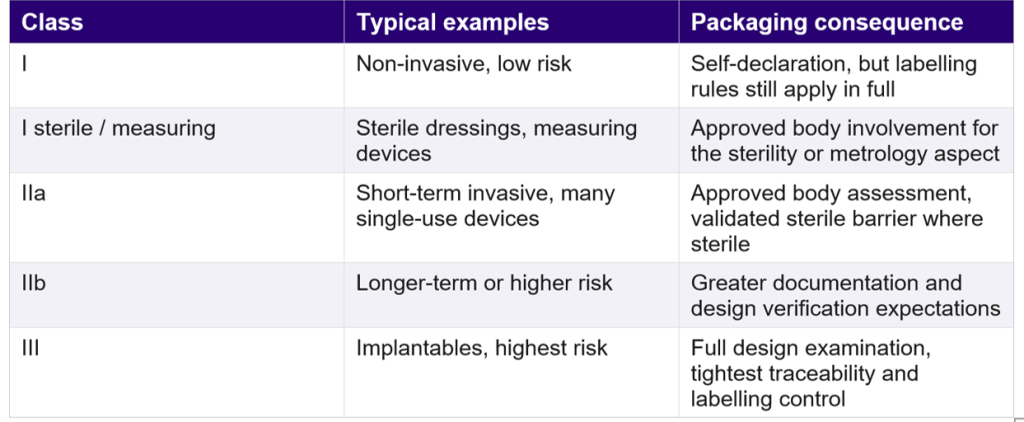
The pattern is straightforward. The higher the class, the more of the packaging system sits inside the conformity assessment, and the less freedom there is to change a material, supplier or process without formal evaluation.
Labelling content and symbols
Device labelling must allow safe identification and use: the device name and intended purpose where not obvious, the manufacturer's name and address, the UKRP where applicable, the batch or serial number, sterility state and method where sterile, single-use status, storage and handling conditions, the expiry date, and any warnings.
Symbols do much of this work. ISO 15223-1 defines the harmonised symbols used on device labelling, covering manufacturer, date of manufacture, use-by date, batch code, catalogue number, sterilisation method, do not re-use, do not use if package is damaged, and consult instructions for use. They reduce translation burden across markets, but only work when they are the current version of the symbol and carry the correct explanatory text.
UDI, instructions for use and eIFU
Unique device identification pairs a device identifier with production identifiers such as lot, serial and expiry, carried in machine-readable form on the label. UDI is established in other major markets and the MHRA has set out its intention to introduce UK requirements, so most manufacturers already apply GS1-based carriers to avoid re-artworking later.
Instructions for use are a controlled component, like a patient information leaflet. They must be the correct version, correctly folded and physically present unless the device qualifies for electronic instructions. Where eIFU is permitted, typically for defined professional-use devices, the pack still has to carry the information needed to find them and a paper copy must remain available on request.
Sterile barrier systems and ISO 11607
For a terminally sterilised device, the packaging is the sterile barrier, and ISO 11607 governs it in two parts: Part 1 for materials and packaging system design, Part 2 for validation of the forming, sealing and assembly processes. The regulatory consequence is what matters here. That validation evidence forms part of the technical documentation supporting conformity, so a device that passes every performance test but fails its packaging validation cannot be placed on the market, because the sterility claim cannot be substantiated to the stated shelf life.
It also constrains change control. Once a sterile barrier is validated, a material substitution or a move to a different sealing process is a regulatory event, not a procurement decision, and the packer has to raise it rather than absorb it. The design, material and test method detail sits in our article on medical device packaging design.
Post-market surveillance and vigilance
The post-market surveillance regulations strengthened the reporting timelines a manufacturer and its partners must meet. A serious public health threat must be reported within 2 days. A death or an unanticipated serious deterioration in health must be reported within 10 days. Mandatory trend reporting sits alongside these, covering statistically significant increases in the frequency or severity of incidents that are not otherwise individually reportable.
For a packing partner the requirement is speed and traceability. When a complaint arrives, the manufacturer needs batch records, component traceability, label reconciliation and retained samples fast enough to make a 2-day or 10-day decision. That is a records discipline question, and a fair thing to test during a supplier audit.
What this means for choosing a medical packaging company
ISO 13485 is the gate. It is the quality management system standard for medical devices, and it differs from ISO 9001 in ways that matter: mandatory risk management across the lifecycle, stricter document and record retention, explicit cleanliness and contamination control requirements, and controls on design and process validation. A contract packer without ISO 13485 cannot sit inside a device manufacturer's quality system without a great deal of extra justification.
Beyond the certificate, the questions worth asking a prospective medical packaging company are specific. How is artwork version control managed, and who signs off a symbol change? How are instructions for use reconciled at the end of a run? How is traceability maintained for kits built from several suppliers' components? How quickly can batch documentation be retrieved for a vigilance investigation? And how are changes controlled, given that a change a packer treats as routine may invalidate a conformity assessment.
Central Pharma holds both ISO 13485 and ISO 9001 and packs for the medical device sector, alongside kitting, inspection services and rework and repack of finished product.
Key takeaways
- Device packaging is regulated as part of the device, and for sterile products it is a functional component rather than a container.
- Great Britain devices sit under the UK MDR 2002 as amended, with UKCA marking and time-limited CE recognition the MHRA consulted on extending in 2026.
- A non-UK manufacturer must appoint a UK Responsible Person, whose name and address appear on the labelling.
- ISO 11607 governs sterile barrier systems in two parts: materials and packaging system design, and validation of forming, sealing and assembly.
- Post-market surveillance requires reporting within 2 days for a serious public health threat and 10 days for death or serious deterioration, plus trend reporting.
Talk to Central Pharma about medical device packing
Central Pharma has been a contract filler and packer to the pharmaceutical, medical device, cell and gene therapy and healthcare sectors since 2006, from a 267,000 sq ft licensed site in Bedford. The site holds ISO 13485 and ISO 9001 within an integrated quality management system, supported by a dedicated QA team, an MHRA MIA and WDA(H), and temperature-controlled warehousing. Secondary packing, labelling, kitting, inspection and rework run in-house. To discuss a medical device packing project, get in touch.
To stay informed on our latest thinking and technology developments, follow us on LinkedIn.