
Cryogenic Storage for Cell and Gene Therapies: Requirements and Risk Factors
Tuesday 22ndSeptember 2026 . Published by Central Pharma



Cryogenic storage is the least forgiving part of cell & gene logistics. A refrigerated product that warms briefly can often be assessed against stability data and released. A cell therapy that crosses its glass transition temperature on the way back up may have lost viability that no amount of subsequent cooling recovers.
This explainer covers what cryogenic storage actually does to a cell product, how the equipment works, and the failure modes that supply chain and quality teams need to plan around. It is written as technical background rather than as a service description, because buyers need to understand the requirement before they can assess who can meet it.
Why cryopreservation is used at all
Living cells have short useful lives at physiological or refrigerated temperatures. Fresh cell products often have viability windows of one to three days, which forces manufacturing, testing, release and infusion into an unmanageably tight sequence. Cryopreservation decouples those steps. It allows quality control and QP certification to complete without a clock running, permits shipment over long distances, and lets a treatment centre hold product until the patient is genuinely ready.
The cost of that flexibility is a far harder storage and transport requirement, and a set of biological risks that only appear during freezing and thawing.
What happens biologically
Freezing damages cells in two main ways. Ice crystals forming inside the cell tear membranes and organelles. Ice forming outside the cell concentrates the remaining extracellular solutes, which draws water out of the cell osmotically and causes solution injury even where intracellular ice never forms.
Cryoprotectants such as dimethyl sulphoxide (DMSO) reduce both effects by lowering the amount of ice formed and moderating the osmotic gradient, typically at 5 to 10 per cent concentration. DMSO is itself toxic to cells at ambient temperature, which is why exposure time before freezing and after thaw is controlled tightly, and why thawed product is normally infused or washed within minutes.
Controlled-rate freezing manages the cooling profile, commonly around 1°C per minute through the critical zone, with a compensating step to manage the latent heat released at nucleation. Too fast and intracellular ice forms; too slow and solution injury dominates.
Below roughly −130°C the remaining unfrozen fraction enters a glassy, non-crystalline state. This glass transition matters operationally: above it, molecular mobility allows ice recrystallisation and progressive damage even though the product looks frozen. Storage therefore has to sit reliably below −150°C, which in practice means liquid nitrogen.
Storage systems
Vapour phase versus liquid phase
Liquid phase storage immerses samples in liquid nitrogen. It gives excellent temperature uniformity, but samples sit in a shared liquid, and a cracked vial or a compromised bag port creates a route for cross-contamination between different patients' materials. Liquid ingress into a container can also cause violent expansion on warming.
Vapour phase storage suspends samples above a shallow liquid nitrogen reservoir, holding them in cold nitrogen gas. Temperatures are typically in the region of −150°C to −190°C depending on shelf height, so uniformity is less perfect and mapping is more important. The cross-contamination risk is substantially lower, which is why vapour phase has become the default for clinical cell and gene therapy material.
Where −80°C fits
Mechanical ultra-low temperature freezers running around −80°C are cheaper, simpler and free of liquid nitrogen supply dependency. They are appropriate for plasmids, viral vector intermediates, some reagents and short-term holding.
For long-term storage of cellular products they are usually not sufficient, because −80°C sits above the glass transition. Slow degradation and viability loss over months are well documented at this temperature. Treating a ULT freezer as equivalent to cryogenic storage is a common and expensive assumption.
Transport: dry vapour shippers
Dry vapour shippers use a hydrophobic absorbent that holds liquid nitrogen within the wall of the vessel, so no free liquid can escape. That construction allows them to travel by air as non-hazardous cargo in most jurisdictions and to be handled in any orientation.
Charged hold times are commonly quoted at 7 to 20 days depending on the model, but the quoted figure assumes a fully charged, undisturbed shipper. Every opening consumes hold time. Plan lanes against a realistic working hold time with genuine margin, not against the datasheet maximum, and specify recharge points for long or multi-leg routes.
Monitoring
Cryogenic storage requires more than a temperature probe. A credible system includes liquid nitrogen level sensors with automatic fill control, temperature probes positioned according to a mapping study rather than convenience, continuous data logging with an audit trail, and alarms that escalate to a named responder with a defined attendance time at any hour. Shippers carry their own loggers, ideally with real-time reporting so a warming trend is visible while the consignment is still recoverable.
The main risk factors and how they are mitigated
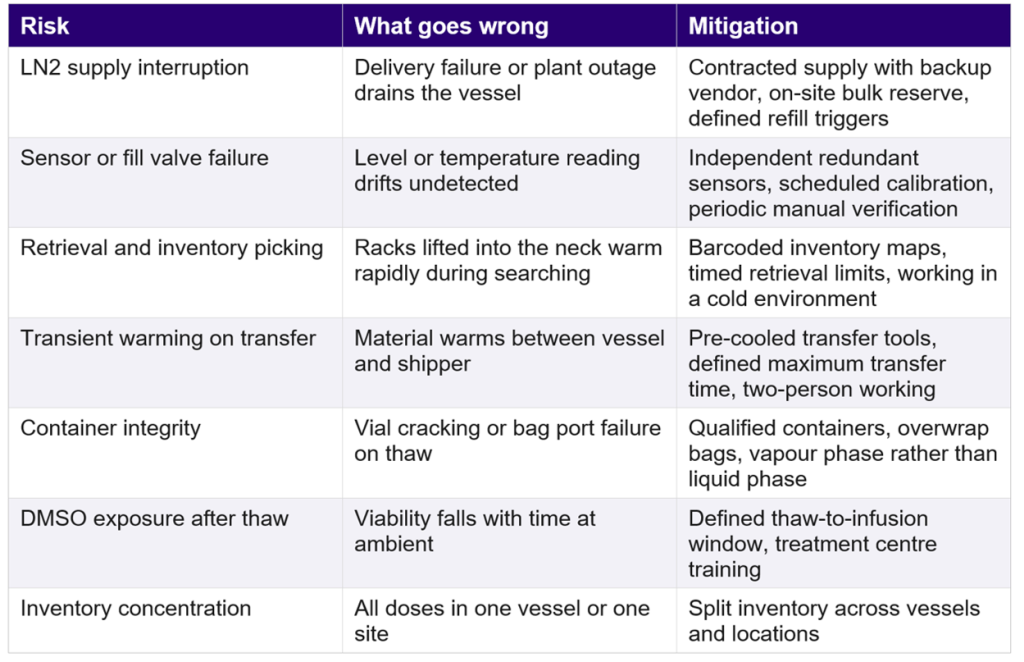
Two further points deserve their own note. Qualification and mapping of cryogenic vessels is not optional: shelf-by-shelf temperature profiles vary considerably in vapour phase, and the top shelf is not equivalent to the bottom. And operator safety is a genuine hazard, not a formality. Liquid nitrogen expands roughly 700-fold on vaporising, creating an asphyxiation risk in enclosed spaces, so oxygen depletion monitoring, ventilation, cryogenic gloves, face protection and trained working practices are all required.
Where Central Pharma fits
The Bedford site operates ambient, +2°C to +8°C refrigerated and −20°C frozen storage within temperature-monitored and controlled warehousing. Where a programme requires deep-cryogenic storage or transport below −150°C, Central Pharma arranges it through specialist approved partners under a defined technical agreement.
What Central Pharma contributes to a cell & gene logistics programme is the licensed activity around the cryogenic steps: GMP and GDP compliant handling under MHRA MIA and WDA(H), labelling, kitting, secondary packing, storage in the bands described above, site of importation status, QP release by three Qualified Persons to more than 60 countries, controlled drug capability and dedicated project management.
Key takeaways
- Cryopreservation exists to decouple manufacture, testing and infusion, and it introduces its own biological risks in exchange.
- Storage must sit below the glass transition of roughly −130°C, which is why −80°C freezers are not a substitute for cryogenic storage of cellular products.
- Vapour phase liquid nitrogen is the clinical default because it removes the shared-liquid cross-contamination route.
- Dry vapour shipper hold times should be planned with margin, since every opening consumes them.
- Most cryogenic failures are operational, involving retrieval, transfer and supply, rather than outright equipment failure.
Talk to Central Pharma about your cell and gene therapy programme
Cryopreservation is one step in a longer chain, and the steps either side of it still need a licensed home: labelling of sterile-filled vials and ampoules, kitting, secondary packing, temperature-monitored storage, GDP-compliant distribution, importation and QP release. Central Pharma provides those from Bedford under MHRA MIA and WDA(H), with dedicated project management holding the sequence together and a documented interface to whoever handles the cryogenic leg. Get in touch to map your programme step by step.
To stay informed on our latest thinking and technology developments, follow us on LinkedIn.