
How Pharma Packaging Design Keeps a Device Sterile for Five Years
Thursday 24thSeptember 2026 . Published by Central Pharma



For a sterile medical device, the pack is not a container. It holds sterility from the moment the device leaves the steriliser until a nurse opens it at the sterile field, sometimes five years later. Get the material, the seal or the ageing evidence wrong and the device cannot be sold, however well it performs.
That is what separates pharma packaging design for devices from packaging design for medicines. A carton for tablets protects and informs. A sterile barrier system is qualified as a functional part of the product, with test data behind every claim on the label. This article covers the standards, the materials and the tests that produce that data.
The sterile barrier system and the packaging system
The vocabulary matters, because the standards use it precisely. The sterile barrier system is the minimum package that prevents ingress of microorganisms and allows aseptic presentation: a pouch, a formed tray with a lidding web, a header bag. It is the layer the sterility claim rests on. Protective packaging is everything added to protect that barrier in transit, from the carton and insert to the shipper and void fill.
The packaging system is the two together, and validation applies to the whole of it. A barrier that survives on the bench and fails after a pallet journey has not been designed properly.
ISO 11607: the standard behind pharma packaging design for devices
ISO 11607 is in two parts and both apply to terminally sterilised devices.
Part 1 covers materials, sterile barrier systems and packaging systems: microbial barrier properties, compatibility with the sterilisation process, biocompatibility of contact materials, and aseptic presentation. Performance must hold across the claimed shelf life and the intended distribution conditions.
Part 2 covers validation of the forming, sealing and assembly processes: installation, operational and performance qualification of the sealing equipment, built around a defined seal window of temperature, pressure and dwell time, plus web speed on a rotary sealer. Operational qualification finds the edges of that window by sealing at the extremes and testing what comes out. Performance qualification then shows the process holds at nominal settings across consecutive runs. This is the packer's obligation, and what a contract packer should evidence before running your product.
Design change and process change are rarely separable. Move from a medical paper to a Tyvek lid, change tooling or change web supplier, and the seal window shifts, so the qualification has to be repeated.
Material selection and sterilisation compatibility
Material choice is driven first by the sterilisation method, then by device geometry.
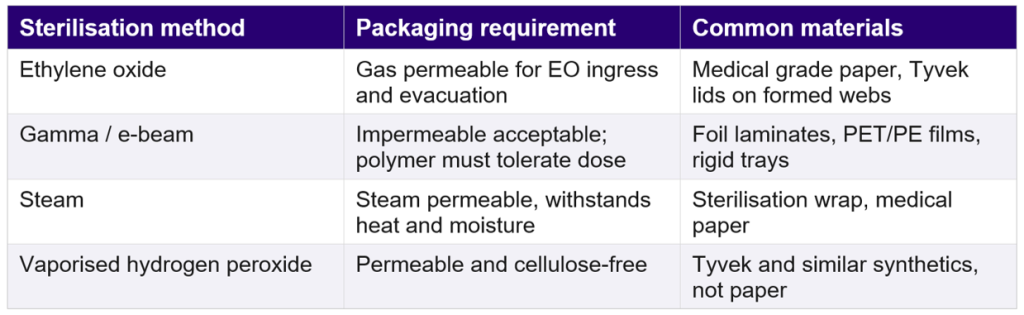
Two points cause repeated trouble. Gamma and e-beam change polymer properties: some grades of polypropylene embrittle, some adhesives discolour, and printed inks can shift shade enough to fail a visual specification. Test the actual pack after irradiation at the maximum dose the load will see. And hydrogen peroxide is incompatible with cellulose, so an ethylene oxide design cannot be carried across unchanged.
Geometry then sets the format: four-side-sealed pouches, header bags, thermoformed trays with a peelable lid, or formable webs run on a form-fill-seal line. Trays hold the device in position for presentation; pouches cost less but protect less in transit. Sharp edges and protruding tips are the usual cause of pinholes, and are better answered in pharma packaging design with a restraint or a rigid tray than with heavier film.
Seal integrity and seal strength testing
Two properties get confused. Seal strength is the force required to separate the seal. Seal integrity is whether a channel could allow microbial ingress. A pack can be strong and leaky, or intact and impossible to peel. The methods most often specified:
- ASTM F88 seal strength, measured as peel force on a cut strip, with the grip technique stated and the failure mode reported as adhesive peel, cohesive failure or material tear.
- ASTM F1140 unrestrained burst and creep of the whole package, a process control indicator rather than an integrity test.
- ASTM F1929 dye penetration, which finds channel defects in seals between a porous web and a transparent film.
- ASTM F2096 bubble emission, an internal pressurisation test for gross leaks where dye cannot be used.
- ASTM F1886 visual inspection against defined attributes for channels, incomplete seals and foreign matter.
These are test methods, not acceptance criteria: the limits are yours to set and justify, and they must hold at the low end of the seal window as well as at nominal settings. Visual inspection is not the soft option either. It is the one test performed on every pack, so the defect catalogue and operator qualification behind it matter.
Aseptic presentation
A seal that cannot be opened cleanly is a design failure. The device has to reach the sterile field without the outer surface of the pack contacting it and without fibre tear or particulate. That means a continuous, even peel rather than a stick-slip release, a chevron large enough for a gloved hand, and a peel force high enough to survive distribution but low enough to open without the pack snapping back. Assess presentation on aged and transport-conditioned samples, because a pack peels differently after a lorry journey than it does off the sealer.
Transport, ageing and shelf life
Distribution simulation shows the packaging system survives real handling. ASTM D4169 provides cycles covering handling drops, vehicle vibration, compression and, where relevant, low pressure. ISTA procedures serve the same purpose with profiles matched to shipment type. Condition samples to the extremes of the intended route first, then repeat integrity and strength testing.
Shelf life is established under ASTM F1980. Accelerated ageing at elevated temperature supports the claim while real-time ageing runs in parallel, using a conservative Q10 assumption to convert oven time into claimed years. Real-time data is the evidence; accelerated data is the interim justification. Start both together.
Where the UK regulatory position fits
This design and test evidence sits inside a regulatory framework: conformity marking, labelling content and symbols, the UK Responsible Person and post-market surveillance reporting. Our article on regulatory considerations for medical device packaging in the UK sets out that position in full, and the transitional dates are worth confirming before artwork is committed.
Key takeaways
- Sterile barrier system, protective packaging and packaging system are distinct concepts in ISO 11607, and the whole system is validated.
- ISO 11607-1 governs materials and design; ISO 11607-2 governs validation of forming, sealing and assembly, which is the packer's obligation.
- Sterilisation method drives material choice: ethylene oxide and steam need permeability, gamma and e-beam can embrittle polymers, hydrogen peroxide rules out cellulose.
- Seal strength and seal integrity differ, and are tested by ASTM F88, F1140, F1929, F2096 and F1886 against limits you set and justify.
- Shelf life rests on real-time ageing to ASTM F1980, with distribution performance shown under ASTM D4169 or ISTA.
Talk to Central Pharma about medical device packing
Central Pharma is a contract filler and packer to the pharmaceutical, medical device, cell and gene therapy and healthcare sectors, working from a 267,000 sq ft licensed site in Bedford since 2006. We are not your design agency. We review the pharma packaging design you bring us, feed manufacturability and machine qualification input back to your design team, control artwork versions through to QA sign-off, and run the pack under ISO 13485 and ISO 9001. Secondary packing, labelling, kitting, inspection and rework run in-house. Contact us to discuss a project.
To stay informed on our latest thinking and technology developments, follow us on LinkedIn.
Contact Us Today View all news