
GDP Compliance in Cell and Gene Therapy Logistics: What Is Different from Standard Pharma?
Thursday 24thSeptember 2026 . Published by Central Pharma



The rulebook is the same document. EU Guidelines on Good Distribution Practice of medicinal products for human use, 2013/C 343/01, retained in UK law and enforced by the MHRA through the Wholesale Dealer's Authorisation, WDA(H), with a named Responsible Person. If you already run a compliant wholesale operation, none of the chapter headings will be new to you.
What changes in cell and gene therapy logistics is what each chapter means in practice. GDP was written with pallets of stock in mind: interchangeable units, expiry-driven rotation, returns that can go back to saleable stock, recalls that reach distributors. An autologous ATMP is none of those things. It is one patient's material, scheduled against a treatment date, with no substitute in existence.
What follows walks the GDP chapters and sets out where ATMP distribution diverges.
Quality system: a deviation cannot simply end in rejection
In conventional distribution, the safe answer to an unresolved quality question is rejection. Quarantine, destroy, replace.
For a patient-specific ATMP, that answer destroys the treatment. The product is the patient's only option, and the clinical consequence of withholding it may be worse than the quality risk being investigated. Quality systems in cell and gene therapy logistics therefore support a different decision: a documented, time-bounded risk assessment involving the sponsor or marketing authorisation holder, the QP and the treating clinician, weighing the deviation against the patient's condition.
Deviation procedures consequently need defined escalation routes, named decision-makers reachable out of hours, and turnaround measured in hours rather than working days. The record has to justify the clinical reasoning, not just the quality one.
Personnel: specialist competence, not general warehouse training
GDP requires trained staff and a Responsible Person with authority. In an ATMP chain the competence required is narrower and deeper. Operators handle dry vapour shippers, read loggers on time-critical units, work to patient-specific documentation, and understand why a unit that looks like every other unit cannot be substituted for any of them.
Training records need to evidence that competence, and the RP needs enough understanding of ATMPs to judge excursions and disposition soundly. An RP whose experience is entirely in ambient generics will struggle with the first cryogenic excursion at 3am.
Premises and equipment: qualification extends well beyond racking
Standard GDP qualification covers mapped storage areas, calibrated monitoring and controlled access. ATMP work adds equipment classes most wholesalers never touch.
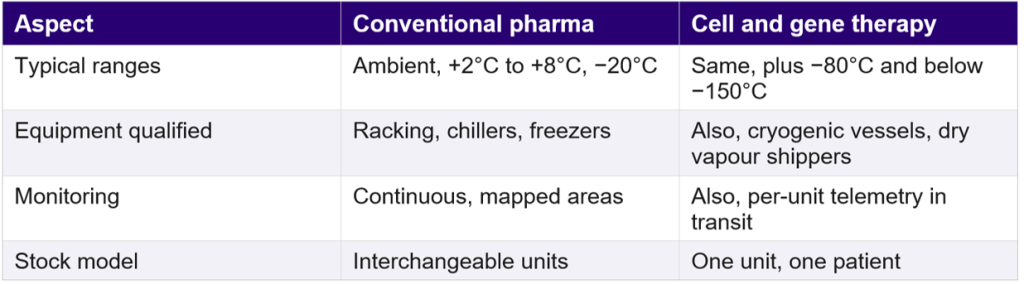
Dry vapour shippers need qualification of charge hold time under realistic conditions, not just the manufacturer's claim. Cryogenic vessels bring liquid nitrogen handling, oxygen depletion monitoring and their own safety regime. Almost no single organisation owns every band in a CGT chain, so each party qualifies the equipment it operates and the technical agreement records who is accountable at each interface. Central Pharma operates ambient, +2°C to +8°C and −20°C storage in temperature-monitored warehousing at Bedford, and works with specialist approved partners on deep-cryogenic steps.
Documentation: longer retention and a donor-to-recipient link
ATMPs sit under traceability obligations running far longer than conventional retention periods, reflecting the need to trace a genetically modified product back to its donor decades later.
The second difference is structural. Conventional records link batch to customer. ATMP records must link donor to recipient at individual level, and remain retrievable across organisations that may not all still exist. Archive format, system migration and data ownership on contract termination become GDP questions rather than IT questions.
Operations: patient-scheduled, and FEFO is meaningless
This is the widest gap. Conventional operations are stock-driven: receive, quarantine, release, rotate by FEFO, pick.
For a patient-specific unit, FEFO has no meaning. There is one unit and one destination. Receipt is not a stock transaction but a reconciliation against an expected patient identifier and a scheduled treatment date. Storage is short-term custody of a single item that cannot be substituted. Supply is scheduled backwards from a hospital slot, with lymphodepletion already underway, so a delivery window is a clinical constraint rather than a service level. Customer qualification changes too: the counterparty is a treatment centre with its own accreditations and receiving process, not a distributor.
Returns: largely impossible
GDP allows returns to saleable stock where storage conditions were maintained throughout, packaging is intact and the RP approves.
For a thawed autologous product, none of that applies. There is no stock to return to, and no other patient can receive it. Where a treatment is cancelled at short notice, the realistic options are a documented return to controlled storage if the product never left it, or disposal with full reconciliation. Procedures should say so plainly rather than reproducing the generic returns chapter.
Falsified medicines and recalls look different
Falsification risk in a patient-specific chain is not counterfeit product entering wholesale channels. There is no open market for one patient's cells. The realistic threats are identity substitution, tampering in transit and diversion, addressed by chain of identity and custody controls rather than pack-level verification schemes.
Recall changes shape too. A conventional recall is a market action reaching distributors and pharmacies. An ATMP recall usually involves a small number of identified patients contacted individually, often after administration, making it a pharmacovigilance and clinical communication exercise as much as a distribution one.
Outsourced activities: many parties, dense technical agreements
Chapter 7 obligations multiply in a vein-to-vein chain. One treatment may involve a collection centre, a courier, a manufacturing site, a storage provider, an import agent and a treatment centre.
Every interface needs a technical agreement stating who holds which authorisation, who verifies identity at each handoff, who is notified of an excursion and within what time, who decides disposition, and who owns the data. Ambiguity at an interface is where ATMP chains fail.
Transportation, HTA and the blurred GMP boundary
Transport qualification expectations run considerably higher than for conventional product: qualified shipping systems, justified lanes and transit times, per-shipment telemetry, and contingency for delay. A generic validated lane is not sufficient evidence for a unit that cannot be replaced.
Two interfaces sit alongside GDP. The Human Tissue Authority has a role where human tissues and cells are procured, tested and stored, so licensing may span both regulators. And because the product is still patient-specific while being handled, the line between manufacturing and distribution blurs: activities that look like distribution may fall under GMP for ATMPs and the MIA rather than the WDA(H). Deciding which authorisation covers which step is an early design decision.
Key takeaways
- GDP applies to ATMPs, but each chapter's practical meaning changes because the product is patient-specific and irreplaceable.
- Deviations cannot default to rejection; decisions need a documented clinical and quality risk assessment with named out-of-hours decision-makers.
- FEFO and conventional returns are meaningless for a patient-specific unit, and recalls become individual patient notifications.
- Qualification extends to dry vapour shippers and cryogenic vessels, and traceability retention runs far beyond conventional periods.
- Technical agreements at every interface, and clarity on where GMP ends and GDP begins, hold the chain together.
Talk to Central Pharma about cell and gene therapy logistics
An ATMP chain benefits from a partner holding both authorisations, because the GMP and GDP boundary rarely falls neatly between two companies. Central Pharma operates under MHRA MIA and WDA(H) from Bedford, with three Qualified Persons, QP release to more than 60 countries, site of importation status and a dedicated QA team, so packing, storage, release and distribution sit inside one quality system and one deviation process. Storage covers ambient, +2°C to +8°C and −20°C, alongside Schedule 1 to 5 controlled drugs, labelling of sterile-filled vials and ampoules, kitting, inspection, pick and pack and dedicated project management. Talk to us about where the boundaries in your chain should fall.
To stay informed on our latest thinking and technology developments, follow us on LinkedIn.
Contact Us Today View all news