
GMP vs GDP in Pharmaceutical Packaging
Wednesday 2ndSeptember 2026 . Published by Central Pharma



GMP and GDP get used almost interchangeably in supplier conversations, and that causes real problems. They are different legal regimes, under different authorisations, inspected differently, with a precise boundary between them. Choosing a pharmaceutical packaging company without understanding that boundary is how organisations end up with a batch that is packed but stranded, or stock that has to move sites before it can be shipped.
The short version: GMP covers making and packing a medicine, up to and including certification by a Qualified Person. GDP covers what happens to the product after that point, while it is stored and distributed. A site doing both needs both authorisations. This article explains what each regime requires, where the handover sits, and why it matters commercially.
GMP: everything up to QP certification
Good Manufacturing Practice governs the manufacture and packing of medicinal products. In the UK the MHRA enforces it through the Manufacturer's / Importer's Authorisation, the MIA. Any site packing a licensed human medicine, including secondary packing and labelling, must hold one. In practice that means a defined set of controls a buyer can ask to see:
- Validation and qualification. Equipment, processes and computerised systems are qualified and revalidated on a defined basis, and new pack formats qualified before commercial running.
- Batch documentation. A batch packaging record captures every step, signed and checked contemporaneously. This is the evidence the QP relies on.
- Line clearance. Before a batch starts, the line is cleared of all previous product, components and printed materials, documented and independently checked.
- Reconciliation. Components issued, used, rejected and returned must reconcile within defined limits. Printed components are reconciled tightly because they carry product identity.
- Deviations and change control. Anything off plan is recorded, investigated and assessed for impact. Changes are approved before implementation, not after.
- Qualified Person certification. The QP certifies each batch, confirming manufacture and testing accorded with GMP and the marketing authorisation.
GDP: everything after release
Good Distribution Practice governs the storage and distribution of medicinal products already released. In the UK it is enforced through the Wholesale Dealer's Authorisation (Human), the WDA(H), against the EU Guidelines on Good Distribution Practice of medicinal products for human use, 2013/C 343/01, retained in UK law.
GDP has its own named role. Where GMP has the Qualified Person, GDP has the Responsible Person, named on the WDA(H) and personally accountable for the quality system covering wholesale activities. The practical requirements include:
- A documented quality system covering wholesale operations.
- Qualified and mapped storage areas, with temperature mapping and continuous monitoring, and calibrated equipment.
- Qualification of both suppliers and customers, so product is only received from and supplied to legitimately authorised parties.
- Controls on returns, on suspected falsified medicines and on recalls, including the ability to trace and retrieve stock.
- Validated transport, so conditions are maintained in transit.
- Self-inspection on a planned cycle.
The handover point: QP certification
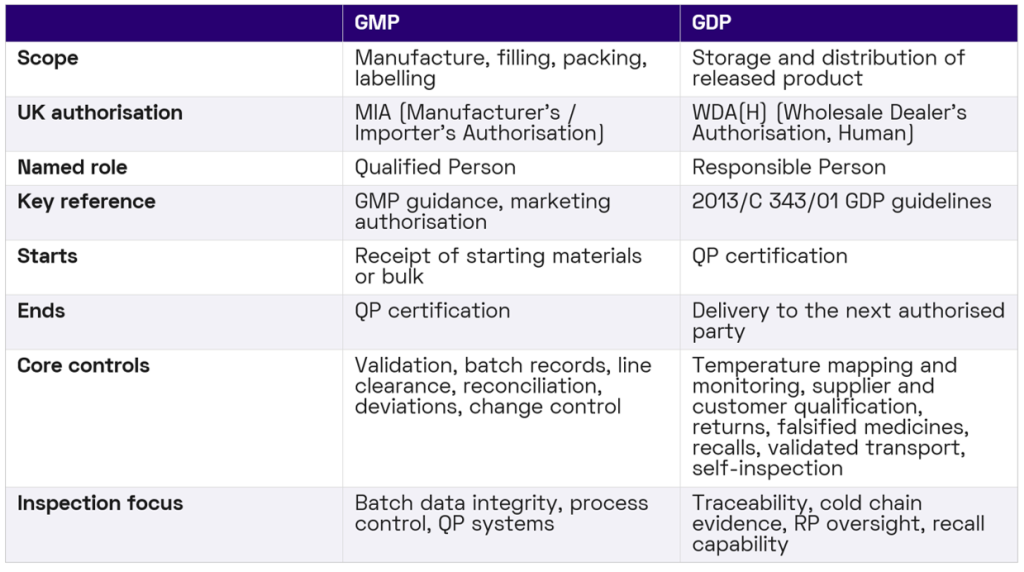
The boundary is precise. GMP applies up to and including QP certification. The moment the QP certifies the batch, the product becomes released stock and GDP applies from there. Before certification the product sits under the MIA and the QP; after certification, under the WDA(H) and the Responsible Person.
Two consequences follow. Product held on site before certification is not distributable, even if physically finished and boxed. And if released product needs to be reworked, repacked or relabelled, it comes back under GMP and the MIA and needs recertification before it can be released again. A site holding only a WDA(H) cannot legally do that work.
GMP vs GDP at a glance
Where the two overlap on one site
On a site holding both authorisations, GMP and GDP coexist physically but not procedurally. The same warehouse can hold quarantined bulk awaiting packing and certified stock awaiting despatch. What separates them is status, documented and system-controlled, rather than a wall.
That places weight on a few things. Stock status control must be unambiguous, so nobody picks uncertified product. The quality system should be genuinely integrated, with one deviation process, one change control process and one CAPA system covering both regimes rather than two sets of paperwork in parallel. Temperature-controlled storage must satisfy GDP mapping and monitoring expectations while supporting GMP operations. And the QP and RP need a clear working relationship, because the handover happens on every batch.
What MHRA inspections look for
MHRA inspects the two separately, and the tone differs.
A GMP inspection follows the product and the paperwork. Inspectors trace batches through the records, test data integrity, examine validation packages, look hard at deviations and CAPA effectiveness, review line clearance and reconciliation, and examine how the QP is supported: what information the QP sees, and whether an informed decision was realistically possible.
A GDP inspection follows traceability and conditions. Inspectors check the Responsible Person is genuinely in post and exercising oversight, review temperature mapping and monitoring data including alarm handling and excursion investigations, test supplier and customer qualification records, and often run a mock recall to see whether stock can be identified and retrieved in a sensible time.
Both are risk-based and both can produce findings classified as critical, major or other. Ask a prospective partner for the outcome of the most recent inspection of each.
Why a pharmaceutical packaging company should hold both
For a buyer, the practical argument is about handoffs. If your packer holds only an MIA, certified stock must transfer to a separate licensed warehouse before distribution. That transfer is a transport risk, a goods-in inspection, a potential temperature excursion, a second set of records and a second contract to manage. If a rework is needed later, the stock travels back.
A single site holding both authorisations removes those movements. Bulk arrives, is packed under GMP, is certified by an on-site QP, changes status to released, and moves into GDP-controlled storage and distribution without leaving the building. Traceability stays in one system and accountability with one organisation. Central Pharma holds both an MHRA MIA and a WDA(H) at Bedford, alongside FDA registration for secondary packing and labelling, a Home Office licence for Schedule 1 to 5 controlled drugs and an MHRA API storage licence.
Key takeaways
- GMP governs manufacture and packing under the MIA; GDP governs storage and distribution of released product under the WDA(H).
- QP certification is the exact boundary between the two regimes, and it determines which rules and which named role apply.
- Reworking or relabelling released product brings it back under GMP and requires recertification before it can be released again.
- GMP inspections focus on batch data integrity and QP support; GDP inspections focus on traceability, temperature evidence and recall capability.
- A site holding both authorisations removes a physical transfer, a second contract and a second set of records from your supply chain.
Talk to Central Pharma about GMP and GDP under one roof
Choosing a pharmaceutical packaging company that operates under both an MIA and a WDA(H) means your product can be packed, certified, stored and distributed without changing site or custodian. Central Pharma has done exactly that from Bedford since 2006, with three Qualified Persons, an integrated quality management system, ISO 9001 and ISO 13485 accreditation, more than 10,000 pallet locations across ambient, +2°C to +8°C and −20°C storage, and product QP released to over 60 countries. To discuss your requirements, get in touch.
To stay informed on our latest thinking and technology developments, follow us on LinkedIn.
Contact Us Today View all news