
Pharmaceutical Logistics: What It Involves and How to Select a 3PL Partner
Wednesday 2ndSeptember 2026 . Published by Central Pharma



Most tender documents for pharmaceutical distribution describe the destination and the volume. Very few describe the twenty or so controlled handoffs that sit between a batch leaving a manufacturing site and a pack reaching a pharmacy, hospital or patient.
That gap is where problems come from. A pharmaceutical logistics company is not simply moving boxes under a quality label. It is operating a licensed chain of custody in which every transfer, storage condition and document has to be defensible to the MHRA, to the marketing authorisation holder and, if something goes wrong, to a recall investigation.
This article sets out what pharmaceutical logistics involves in practice, then how to assess a partner against it.
The scope of pharmaceutical logistics
Inbound receipt and importation
Everything starts at goods-in. Receipt against purchase order, verification that the supplier is qualified and authorised to supply, review of in-transit temperature data, inspection for damage and tampering, capture of batch numbers and expiry dates, then put-away to a quarantine location under system control.
Where product originates outside the UK, importation adds a further layer. Imported medicinal product must be certified by a Qualified Person at the UK site of importation before it can be released to market, which is why "Site of Importation" and "Site of QP Release" are meaningful commercial capabilities rather than badges. A site that holds both can take physical receipt, hold under GDP conditions, complete the certification and release into the UK or onward supply chain without a further transfer. Central Pharma's Bedford site is both a site of importation and a site of QP release, with three Qualified Persons and product QP released to more than 60 countries.
Storage
Storage under GDP means mapped and qualified conditions, continuously monitored with calibrated sensors, alarmed, with a Responsible Person named on the WDA(H) accountable for the quality system. Stock is held by status, quarantine, released, rejected, returned or recalled, and rotated FEFO so that shortest-dated stock is picked first.
Order management, pick and pack
Order management covers customer master data, allocation rules, batch selection, minimum remaining shelf life at despatch, and the checks that stop the wrong product going to the wrong customer. Picking may be full pallet, case or unit level. Healthcare pick and pack typically involves mixed orders, kitting, and packing configurations chosen so that the product stays within its permitted conditions for the whole journey, not just at the point of despatch.
Transport
Transport is where most temperature excursions actually happen. Controlled distribution requires vehicles or packaging systems qualified for the required range, defined loading procedures, in-transit monitoring where risk assessment calls for it, and route or lane qualification for anything unusual in duration, ambient extremes or number of handoffs. GDP treats transport as an extension of the storage obligation, so the same evidence standard applies.
Export documentation
Export moves the burden onto paperwork. Destination market requirements, customs documentation, certificates of analysis and conformity, batch certification records, licence checks for controlled substances, and serialisation data where the receiving market requires it. Note that there is currently no mandatory medicines serialisation scheme for the UK domestic market, EU FMD safety features having ceased to apply in Great Britain from January 2021 and in Northern Ireland from January 2025. Serialisation is therefore an export requirement for UK operations, driven by EU FMD, US DSCSA and other regulated markets.
Returns and recalls
Returns arrive with an unknown storage history, so they are quarantined pending an assessment of whether they can re-enter saleable stock. Recall is the capability nobody tests until they need it: the ability to identify every unit of a batch, everywhere it went, and retrieve it quickly. Ask a prospective partner when they last ran a mock recall and what the reconciliation percentage and elapsed time were.
How to select a pharmaceutical logistics company
Once you understand the scope, selection becomes a matter of evidence rather than impression. The table below covers the criteria worth pressing hardest on.
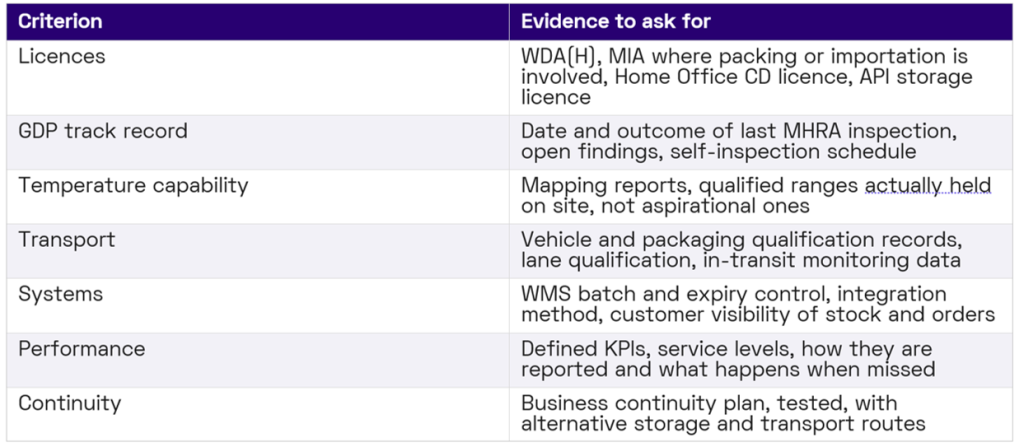
A few of these deserve expanding.
Licences and quality system. Check that the authorisation actually covers what you need, including the product categories and any controlled drugs. If controlled substances are in scope, the partner needs a Home Office licence and safe custody compliant storage under the Misuse of Drugs Regulations 2001, covering the relevant schedules.
Temperature range. Ask what the site holds in house rather than what it can arrange. Central Pharma's Bedford site holds ambient, +2°C to +8°C refrigerated and −20°C freezer storage. Where a programme needs deeper cold, a credible partner names the specialist approved partner handling that step.
Data visibility. Real-time stock, order and condition data reduces the number of phone calls your team makes. Ask how data reaches you, at what frequency, and whether temperature records are available on demand or only after a request.
KPIs and service levels. On-time despatch, order accuracy, stock accuracy, temperature excursion rate, deviation closure time and complaint response time are all measurable. Agree the definitions before contract, because "on time" measured at despatch and "on time" measured at delivery produce very different numbers.
Business continuity. Ask what happens if a chiller fails, a vehicle is off the road, or the site is inaccessible. The answer should reference a tested plan with named alternatives, not general reassurance.
Fleet and sustainability. Transport emissions are increasingly reported through customers' own supply chain disclosures. Central Pharma operates in-house electric vehicles alongside a network of approved, audited transport vendors, which gives a mix of controlled in-house delivery and wider geographic reach.
Key takeaways
- Pharmaceutical logistics spans receipt, importation, GDP storage, order management, pick and pack, transport, export documentation, returns and recalls, and each stage carries its own regulatory obligation.
- A site holding both importation and QP release removes a transfer step and shortens the path from arrival to UK market release.
- Transport is the highest-risk stage for excursions, so qualified vehicles or packaging, lane qualification and in-transit monitoring matter as much as warehouse conditions.
- Select a pharmaceutical logistics company on documented evidence: licences, inspection history, mapping reports, qualification records and tested continuity plans.
- Serialisation is an export requirement for UK-based operations, not a domestic one, so check the partner's capability against your destination markets.
Talk to Central Pharma about Pharmaceutical logistics
If you are running a 3PL selection, Central Pharma is worth putting on the evidence list. Importation, GDP storage, order management, pick and pack, export documentation and distribution sit under one quality system at Bedford, with MHRA MIA and WDA(H) authorisations, three Qualified Persons and product QP released to more than 60 countries. That combination removes the transfer between the site that receives your product and the site that releases it, and it puts one Responsible Person and one set of records behind the whole journey, including Schedule 1 to 5 controlled drugs and delivery by in-house electric vehicles or approved transport vendors. Get in touch and ask us for the documents this article tells you to ask for.
To stay informed on our latest thinking and technology developments, follow us on LinkedIn.
Contact Us Today View all news