
Pharmaceutical Packaging Regulations in the UK
Thursday 27thAugust 2026 . Published by Central Pharma



Ask three people which rules govern pharmaceutical packaging in the UK and you will often get three answers, all partly right. The law sits in one place, the licensing regime in another, and the market access conditions have moved twice since 2020. Most of the expensive mistakes come from working to the wrong map rather than misreading the right one.
This article sets out the framework: which regimes apply to a UK medicinal pack, who has to be licensed to touch it, what the MHRA enforces, where UK serialisation stands after the Windsor Framework, and how UK requirements have diverged from the EU. For the full list of particulars that must appear on a carton, blister or vial label, see our practical guide to pharmaceutical labelling requirements in the UK; for how those particulars should be laid out so a pack reads safely, see our article on pharmaceutical packaging design and regulatory best practice.
The statute and the regulator
The Human Medicines Regulations 2012 are the principal domestic legislation for medicines in the UK. Part 13 carries the packaging, labelling and patient information leaflet requirements, and it applies to any medicinal product placed on the UK market. Everything else in this area, including MHRA guidance, hangs off that statutory base.
The Medicines and Healthcare products Regulatory Agency enforces it, and since 1 January 2025 has been sole regulator for the whole of the UK, Northern Ireland included. In practice the MHRA meets your packaging twice: at assessment, when artwork is reviewed against the marketing authorisation, and at inspection, when a site is examined against Good Manufacturing Practice. The two are not interchangeable. Approved artwork applied on an unlicensed line is still unlawful, and a well-run line producing an unapproved pack is still producing an unreleasable batch.
Packing a licensed medicine requires an MIA
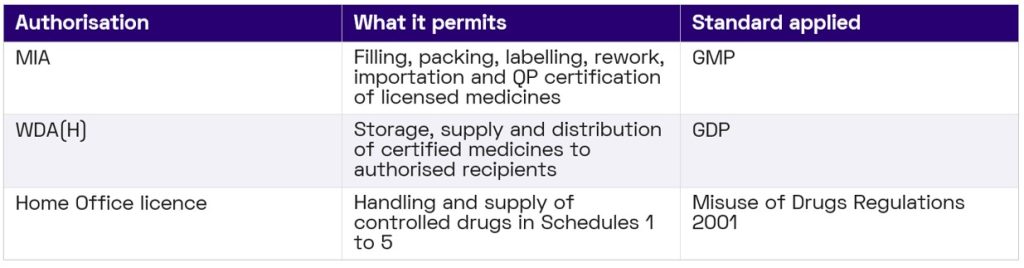
Packing a licensed medicine is a manufacturing operation in law, not a warehousing one. Anyone doing it in the UK must hold a Manufacturer's or Importer's Authorisation issued by the MHRA, operate the site to GMP, and have a Qualified Person named on that licence certify each batch before it goes to market.
The scope catches more activity than people expect. Secondary packing into cartons, labelling of vials, ampoules and other sterile-filled units, rework and repack of finished product, kitting and inspection all fall inside it. So does importation. Where product is manufactured outside the UK, the QP at the UK site of importation is responsible for certification, which is why "Site of Importation" and "Site of QP Release" are commercial facts rather than badges.
An MIA is a continuing commitment, not a one-off approval. It carries a pharmaceutical quality system, qualified premises and equipment, documented change control and deviation management, self-inspection, and written technical agreements wherever an activity is outsourced. The marketing authorisation holder retains responsibility for the product, so that agreement and the audit behind it are part of your compliance, not your supplier's alone.
Where a WDA(H) takes over
Once a batch has been certified, a different regime applies. Storage, supply and distribution of licensed medicines are governed by Good Distribution Practice, the EU Guidelines 2013/C 343/01 retained in UK law, and permitted by a Wholesale Dealer's Authorisation for human medicines.
GDP requires a named Responsible Person, a quality system, qualified and temperature-mapped storage areas with continuous monitoring, calibrated equipment, qualification of both suppliers and customers, controls on returns, falsified medicines and recalls, validated transport, and self-inspection. A site that both packs and distributes needs both authorisations. Central Pharma holds an MHRA MIA and a WDA(H) at its Bedford site, alongside a Home Office licence covering Schedule 1 to 5 controlled drugs and an MHRA API storage licence.
"UK Only" packs and the end of joint EU/UK cartons
All medicines placed on the UK market must carry "UK Only" labelling in a minimum 7-point font, which may appear anywhere on the outer packaging.
From 1 January 2025 joint EU/UK packs are no longer permitted. One carton can no longer serve both markets, so a UK-specific outer is required. Combine that with the rule that statutory information must be printed directly onto the pack rather than applied over it, and the commercial consequence is unavoidable: supplying the UK from foreign-market stock generally means a UK carton and a licensed repacking route, not a sticker. For portfolios built around a shared pack it has meant new artwork, new component codes, additional stock keeping units and a repack plan for existing inventory.
Where UK serialisation actually stands
This is the point most often stated wrongly, so it is worth being plain about it.
EU Falsified Medicines Directive safety features ceased to apply in Great Britain on 1 January 2021. Under the Windsor Framework they also ceased to apply in Northern Ireland from 1 January 2025. EU-compliant 2D barcodes and serial numbers must be removed or covered for the Northern Ireland market, the UK repository system is no longer accessible, and anti-tamper devices are encouraged but no longer mandatory for FMD purposes. There is currently no mandatory medicines serialisation scheme for the UK domestic market.
That does not make serialisation optional for UK packers. It makes it an export condition. Product packed here for the EU still needs a unique identifier in a 2D DataMatrix plus an anti-tampering device, uploaded to the European Medicines Verification System and decommissioned at dispense. Product for the United States needs a DSCSA product identifier, and since 28 May 2026 aggregation and EPCIS interoperable data exchange have been enforceable across trading partners, so every case must report the unit serials it contains. Central Pharma runs serialisation and aggregation in house with dedicated specialists covering global directives.
How UK and EU requirements now diverge
Four divergences drive most of the practical work. Safety features apply in the EU and not in the UK. Pack presentation has separated, with "UK Only" and a UK-specific carton. The regulator differs, with the MHRA covering the whole UK. And certification for imported product must be performed by a UK QP at a UK site.
Taken together, they mean two artwork lineages, two component sets and two change control paths for any product sold in both markets. Planning that once is cheaper than discovering it at a launch date.
Key takeaways
- The Human Medicines Regulations 2012 are the governing statute for UK pharmaceutical packaging, enforced by the MHRA at both assessment and inspection.
- Packing, labelling, rework and importation of licensed medicines all require an MHRA MIA with a Qualified Person certifying each batch.
- Storage and distribution after certification require a WDA(H) under GDP, with a named Responsible Person; a site doing both needs both licences.
- Joint EU/UK packs have not been permitted since 1 January 2025, and UK packs must carry "UK Only" at a minimum of 7-point.
- There is no mandatory UK domestic serialisation scheme, but EU FMD and US DSCSA still apply to exported product, with DSCSA aggregation enforceable since 28 May 2026.
Talk to Central Pharma about your pharmaceutical packaging
Central Pharma has filled and packed for the pharmaceutical, medical device, cell and gene therapy and healthcare sectors since 2006. Its 267,000 sq ft Bedford site holds an MHRA MIA and WDA(H), FDA registration for secondary packing and labelling, a Home Office licence for Schedule 1 to 5 controlled drugs and an MHRA API storage licence, with three Qualified Persons releasing product to more than 60 countries. For UK-compliant packs, imported stock repacked and certified here, or serialised product for export markets, get in touch.
To stay informed on our latest thinking and technology developments, follow us on LinkedIn.
Contact Us Today View all news