
Secondary Packaging Pharmaceuticals Depend On: What It Covers and Why It Matters
Thursday 27thAugust 2026 . Published by Central Pharma



Secondary packaging is where most of a medicine's regulatory identity lives. The tablet is made once, in one strength, to one specification. The carton around it carries the market-specific name, the local language leaflet, the Braille, the barcode and the serial number that lets a supply chain prove the pack is genuine.
Secondary packaging pharmaceuticals rely on is therefore not a commodity finishing step. It is licensed manufacturing under GMP, audited on line clearance discipline and reconciliation arithmetic as much as on throughput.
The primary versus secondary definition is covered elsewhere in this series. This article goes into the operations: what a secondary packing service does, how it is controlled, and why manufacturers place it outside their own four walls.
What a secondary packing service covers
Cartoning
The core operation is placing a primary pack into a printed carton, and every format behaves differently. Blisters run in counted stacks and need pocket depth and stack height controlled so the carton does not bulge. Pots and bottles need collar or partition support so they do not rattle and abrade the label in transit. Sachets are dimensionally variable, so they need a feeding approach that tolerates drift without jamming.
Central Pharma packs blisters, pots and sachets into cartons in Bedford. The primary pack drives the downstream specification: carton dimensions, board grade, glue pattern, closure style and the speed the line will realistically hold.
Leaflet insertion and folding
Patient information leaflets are a controlled component, not filler. They are folded to a defined pattern, checked for the correct version, and inserted so the carton closes cleanly and the leaflet can be removed intact. Leaflet size is a common source of trouble. As markets add languages the leaflet grows, the fold count rises, and a leaflet comfortable at four panels becomes a jamming risk at twelve. Paper weight and grain direction both affect whether it folds predictably at line speed.
Version-controlled leaflet stock, checked at line clearance and reconciled at the end of the run, is one of the clearest signals of a well-run packing operation.
Labelling of vials, ampoules, MDIs and sterile-filled units
Labelling small cylindrical containers is its own discipline. Vials and ampoules are handled by star wheel or roller applicators with wrap tolerance measured in fractions of a millimetre, because a skewed label on a small diameter is both a cosmetic reject and a scanning failure. Metered dose inhalers, pens and other device-format units add curvature and print-surface constraints.
Central Pharma labels vials, ampoules, MDIs and other sterile-filled units. Those units are filled elsewhere and arrive as sealed primary packs, so the labelling operation protects container closure integrity rather than entering it. Handling, vision checking and reject management all reflect that.
Anti-tamper devices, serialisation and aggregation
Serialisation applies a unique identifier to each saleable carton, usually a GS1 2D DataMatrix carrying GTIN, expiry, lot and serial number. Aggregation records the parent-child relationship: which unit serials sit in which case, and which case serials on which pallet.
The UK position is often misunderstood. EU FMD safety features ceased to apply in Great Britain on 1 January 2021, and under the Windsor Framework in Northern Ireland from 1 January 2025. There is currently no mandatory medicines serialisation scheme for the UK domestic market. What does apply is "UK Only" labelling at a minimum of 7 point, and since 1 January 2025 joint EU/UK packs are not permitted, so a UK-specific outer carton is required.
Serialisation is therefore an export requirement for UK packers rather than a domestic one. EU-bound product needs a unique identifier plus an anti-tampering device and upload to the European Medicines Verification System. US-bound product falls under DSCSA, where the stabilisation period ended on 27 May 2026 and interoperable EPCIS aggregation data became enforceable from 28 May 2026. Central Pharma runs serialisation and aggregation with in-house specialists, applies anti-tamper devices and manages reworking data across global directives.
Kitting, bundling and shipper packing
Kitting brings several components into one presentation: a device plus its consumable, a patient starter pack, a diagnostic set. It is component-management heavy, because every item in the kit carries its own lot, expiry and reconciliation trail. Bundling and multipacks matter for retail and tender supply, where cartons are shrink-wrapped or banded into a single sales unit with its own barcode. Shipper packing closes the chain: cases built to a defined pattern, labelled, and where required aggregated to the pallet.
Rework, repack and inspection
Rework is unglamorous and commercially important. Artwork changes, a market switch, a late regulatory variation, a barcode that will not grade. Rather than destroy stock, product is de-cartoned, checked, re-labelled or re-cartoned and returned to a compliant state under full documentation. Inspection sits alongside this: 100% checks on incoming or returned stock, print verification and quarantine handling. Central Pharma offers rework and repack of finished product, inspection services and kitting from Bedford, supported by AI inspection.
Secondary packaging pharmaceuticals: why it is regulated
Secondary packing is manufacturing. Under UK medicines legislation it requires a Manufacturer's / Importer's Authorisation, and every batch is certified by a Qualified Person named on that MIA before release. Central Pharma holds an MHRA MIA and a WDA(H) and has three Qualified Persons. Two controls define day-to-day compliance on a packing line.
Line clearance. Before a run starts, the line is cleared of every component, printed item and unit of product from the previous batch, and the clearance is checked and signed. Mixed product or stray leaflets are among the most serious defects a packing operation can produce, because the patient cannot see them.
Reconciliation. At the end of a run, components issued, units produced, samples taken and rejects destroyed must add up. Printed components, labels and leaflets are reconciled individually because they carry batch-specific information. Serialised packs add a data layer: every serial issued must be accounted for as commissioned, shipped, destroyed or decommissioned.
The commercial case for outsourcing it:
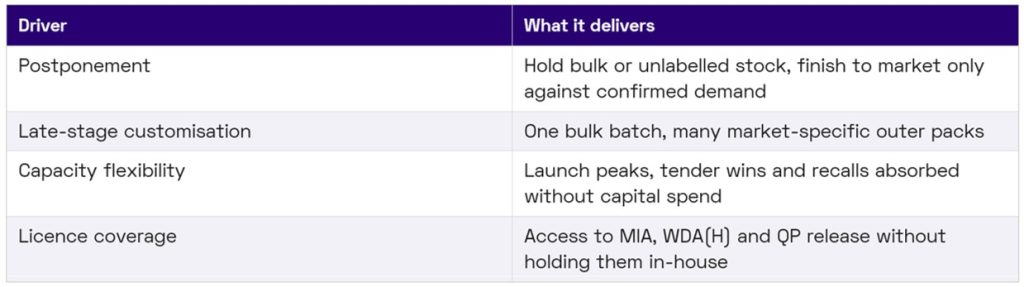
Postponement is the strongest of these. Finished, market-specific packs are expensive to hold and expensive to write off when a forecast moves. Holding product one step back, then cartoning, leafleting, labelling and serialising to order, converts obsolescence risk into short-lead-time packing work. Central Pharma QP-releases product to more than 60 countries, which makes that model workable across a multi-market portfolio.
Key takeaways:
- The secondary packaging pharmaceuticals require is licensed GMP manufacturing, needing an MIA and QP certification, not a warehouse finishing activity.
- Cartoning, leaflet folding and insertion, labelling of sterile-filled units, ATD application, serialisation, kitting, bundling and shipper packing all sit within the service.
- Line clearance and reconciliation are the two controls that auditors examine most closely, and printed components are reconciled individually.
- There is currently no mandatory UK domestic serialisation scheme, so serialisation is primarily an export enabler for EU FMD and US DSCSA markets.
- Late-stage customisation and postponement are the main commercial reasons to place secondary packing with a contract partner.
Talk to Central Pharma about secondary packing
Central Pharma has been a contract filler and packer to the pharmaceutical, medical device, cell and gene therapy and healthcare sectors since 2006, from a 267,000 sq ft licensed site in Bedford. Cartoning of blisters, pots and sachets, labelling of vials, ampoules and MDIs, serialisation and aggregation, kitting, inspection and rework all run in-house, backed by an MHRA MIA, WDA(H), FDA registration for secondary packing and labelling, ISO 9001 and ISO 13485. To discuss secondary packaging pharmaceuticals work, from a single rework campaign to an ongoing multi-market programme, get in touch.
To stay informed on our latest thinking and technology developments, follow us on LinkedIn.
Contact Us Today View all news