
Primary vs Secondary Packaging in Pharma: What is the difference?
Thursday 27thAugust 2026 . Published by Central Pharma



The split between primary and secondary packaging pharma teams work with is not a filing convention. It decides which regulations bite, which materials need qualifying against the product, which areas need environmental control, and which parts of the process can be reworked if something goes wrong.
The definition itself is short. Primary packaging touches the product. Secondary packaging does not. Everything else follows from that single line of contact.
Where it gets expensive is in the consequences. A change to a carton is a change to artwork and a change control. A change to the blister film is a change to the container closure system, which can reach back into stability data and the marketing authorisation.
What counts as primary packaging?
Primary packaging is any component in direct contact with the medicinal product. In practice that means:
- Blister forming film and lidding foil
- Bottles, closures, wads and desiccants
- Pots and tubs with their lids and induction seals
- Sachets and pouches
- Vials, ampoules and their stoppers and seals
- Prefilled syringes and cartridges
- Tubes for creams and ointments
Primary packaging is filled under GMP in controlled conditions. Central Pharma's Bedford site carries out blister packing, pot filling, liquid filling, pouch filling and sachet powder filling, and labels vials, ampoules, MDIs and other sterile-filled units received from elsewhere.
What counts as secondary packaging?
Secondary packaging is everything that goes around the primary pack without touching the product:
- Folding cartons
- Patient information leaflets
- Labels applied to the carton or bottle exterior
- Anti-tamper devices (ATDs)
- Wallets, sleeves and outer wraps
- Bundling and shrink wrapping of retail units
Secondary packing also covers operations rather than components: cartoning of blisters, pots and sachets, rework and repack of finished product, serialisation and aggregation, inspection and kitting.
Tertiary packaging is the transport layer: shippers, cases, pallets, stretch wrap, temperature-controlled shipping containers and their data loggers. It exists to protect and identify product in the supply chain, not to present it to the patient, and it is governed largely by Good Distribution Practice once the batch is released.
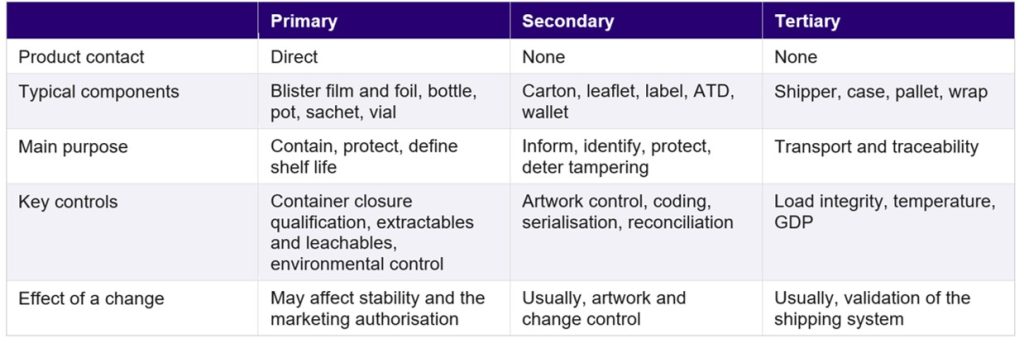
Primary and secondary packaging: pharma obligations compared
Different regulatory obligations
Most statutory labelling requirements attach to the outer, secondary pack. Under the Human Medicines Regulations 2012, Part 13, the required particulars must be printed directly onto the packaging, and over-labelling is not acceptable for standard UK market packs. The product name must appear in Braille on the outer packaging of patient-use medicines, and the patient information leaflet must be available in accessible formats.
The primary pack carries a reduced set of information, but MHRA best practice guidance expects the name and strength to be repeated over each blister pocket or at frequent intervals along the foil, so that a part-used pack stays identifiable.
Market-specific rules also land mainly on the secondary pack. All medicines placed on the UK market must carry "UK Only" labelling at a minimum of 7-point font, and since 1 January 2025 joint EU/UK packs are not permitted, so a UK-specific outer carton is needed. For export, an EU FMD unique identifier and anti-tampering device, or a US DSCSA product identifier, are applied to the outer carton, never to the blister.
Different material qualification
Primary components are qualified against the product. That means compatibility studies, extractables and leachables assessment where the risk profile calls for it, barrier performance data, and stability studies run in the proposed container closure system. The shelf life granted in the licence is tied to that system.
Secondary components are qualified against the process and the machine: board grade and grain direction that run reliably through the cartoner, leaflet fold and dimensions that feed without jamming, label substrate and adhesive that hold on the intended surface, ink systems that give a readable code. Nobody runs a leachables study on a carton.
Different environmental controls
Primary filling exposes open product, so it needs defined room classification, air handling, gowning, cleaning validation and tighter line clearance. Secondary packing handles closed primary packs, so requirements are proportionate: still GMP, still controlled and segregated, but without the same exposure risk. Sites doing both need to manage the transition between the two, including how part-processed material is held, labelled and reconciled.
Different validation and rework consequences
Primary packing validation focuses on process parameters that determine pack integrity: seal temperature, pressure and dwell, fill accuracy, torque, weight. Secondary packing validation focuses on correctness and traceability: right leaflet, right carton, right code, right serial number, correct aggregation.
The practical difference shows up when something goes wrong. A carton coded with the wrong expiry can usually be reworked, which is a documented, controlled decarton-and-repack activity. A blister with a failed seal cannot be repaired, only rejected. Rework of finished product is a routine secondary service and there is no equivalent at the primary stage.
Why single-site sourcing removes handoffs
Splitting primary filling and secondary packing across two suppliers creates a transfer of part-processed, unlicensed-for-sale material between sites. Each transfer brings its own goods-in and goods-out checks, storage conditions to maintain, transport qualification, reconciliation, and a second quality agreement to keep aligned. It also creates the classic argument about which party owns a defect discovered after the handoff.
Doing both at one site removes the transfer. Blisters come off the line and go straight into cartons under the same quality management system, with one batch record, one reconciliation and one QA function. Where the same site is also the site of importation and of QP release, the batch can move from bulk to certified finished goods without leaving the building. Central Pharma runs primary filling and secondary packing across a 267,000 sq ft Bedford site with more than 10,000 pallet locations, temperature-controlled and Schedule 1 to 5 controlled drug storage, and QP release to more than 60 countries.
Key takeaways:
- Primary packaging touches the product; secondary packaging surrounds it; tertiary packaging moves it.
- Statutory labelling, Braille, "UK Only" text, anti-tamper devices and serialisation codes sit on the secondary pack.
- Primary components are qualified against the product through compatibility, leachables and stability work; secondary components are qualified against the machine and the artwork.
- Primary filling needs stronger environmental control, and primary defects generally cannot be reworked, whereas secondary rework is a controlled routine activity.
- Running both stages on one site removes a transfer, a quality agreement and a reconciliation from the supply chain.
Talk to Central Pharma about primary filling and secondary packing
Central Pharma has been a contract filler and packer to the pharmaceutical, medical device, cell and gene therapy and healthcare sectors since 2006. Our Bedford site combines blister, pot, liquid, pouch and sachet filling with cartoning, labelling, rework, serialisation and aggregation, inspection and kitting, supported by an MHRA MIA and WDA(H), ISO 9001 and ISO 13485, three Qualified Persons and status as a site of importation and QP release. To consolidate primary and secondary packaging under one roof, get in touch.
To stay informed on our latest thinking and technology developments, follow us on LinkedIn.
Contact Us Today View all news