
Temperature Controlled Pharmaceutical Storage: Ambient, Chilled, Frozen and Ultra-Low
Monday 7thSeptember 2026 . Published by Central Pharma



"Cold chain" is used loosely to mean anything that is not room temperature. That vagueness causes real problems in tenders, because a site qualified for +2°C to +8°C and a site qualified for -80°C run different equipment, different alarm strategies and different failure plans.
Temperature controlled pharmaceutical storage covers a series of defined bands, each with its own equipment, monitoring approach and failure modes. The band your product needs comes from the marketing authorisation and the stability data behind it, not from a general preference for keeping things cold.
This guide defines each band, then covers the mapping, calibration, mean kinetic temperature and excursion management that apply across all of them.
The Temperature bands defined:
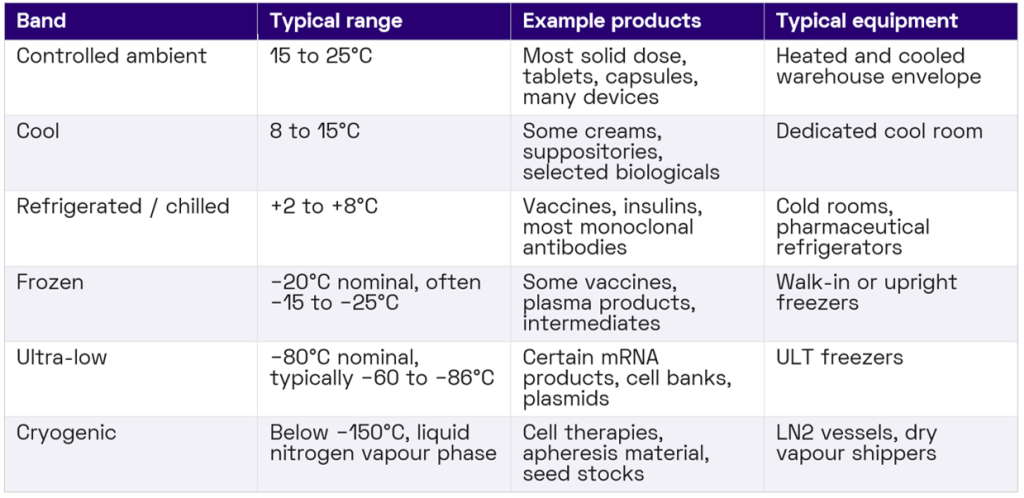
*Always work to the wording of the product's approved storage statement. "Store below 25°C" is not the same instruction as "store at 15 to 25°C", and the difference changes what a warehouse has to demonstrate.
Controlled ambient and cool storage
Controlled ambient is the largest volume band and the one most often taken for granted. A warehouse holding 15 to 25°C across thousands of pallet locations has to manage solar gain through the roof, cold ingress at loading doors, stratification between high and low racking levels and heat from the plant itself.
Monitoring is by fixed calibrated sensors positioned according to the mapping study, concentrated on the hot and cold spots mapping identified. The main failure modes are seasonal: a heatwave pushing high-level locations past 25°C, or extended dock door opening in winter dropping bay locations below range.
Cool storage at 8 to 15°C is a smaller niche served by dedicated rooms. Relatively few sites offer it, so confirm it explicitly rather than assuming it falls out of a chilled installation.
Refrigerated storage at +2°C to +8°C
This is the working definition of pharmaceutical cold chain and covers most vaccines, insulins and antibody products.
Cold rooms are typically built with redundant refrigeration: two independent plant systems, each able to hold the room alone, so a compressor failure does not become a product loss. Backup power, usually a generator with automatic changeover, protects against mains failure. Doors, air curtains and defined handling times limit warm air ingress during picking.
Failure modes cluster around three things. Plant failure is the obvious one, addressed by redundancy. Freezing at the cold end of the range is the underrated one: air discharge points and poorly positioned pallets can drop below 0°C, and for many biologicals a freezing event is more damaging than a brief warm excursion. The third is handling, where product sits on a dock longer than the procedure allows.
Monitoring should be continuous, independently powered, and alarmed to a named out-of-hours responder with a defined attendance time. Central Pharma provides +2°C to +8°C refrigerated storage at Bedford alongside ambient temperature-controlled warehousing.
Frozen storage at −20°C
Frozen storage covers some vaccines, plasma-derived intermediates and bulk material awaiting further processing. Ranges are commonly written as −20°C nominal with an operating band of −15 to −25°C, though the approved statement for the specific product governs.
Equipment is either walk-in freezer rooms or upright and chest freezers, and the practical issues differ from chilled. Frost build-up and defrost cycles cause short, repeated temperature rises that must be characterised during qualification so routine defrosts are not logged as excursions. Door seals degrade. Freezer capacity is usually more constrained than chilled, so allocation and rotation need active management.
Central Pharma holds freezer capacity at −20°C at Bedford, alongside its ambient and +2°C to +8°C storage.
Ultra-low and cryogenic storage: industry context
Below −20°C the engineering changes character. Ultra-low temperature freezers operating around −80°C are used for certain mRNA products, master and working cell banks and plasmid stocks. They rely on cascade refrigeration, reject substantial heat, and are commonly backed by CO2 or LN2 injection that holds temperature through a compressor or power failure. A single ULT freezer is a single point of failure, so sites running them plan spare capacity for emergency transfer.
Cryogenic storage below −150°C uses liquid nitrogen vapour phase and applies mainly to cell and gene therapy material: apheresis starting material, autologous drug product and seed stocks, with dry vapour shippers used for transport. The operational burden includes LN2 supply contracts, oxygen depletion monitoring, confined space and PPE controls, and inventory systems that keep chain of identity intact once material is frozen.
These bands are covered here because supply chain teams need to understand them, not because every provider operates them. The Bedford site operates ambient, chilled at +2°C to +8°C and −20°C frozen storage. Where a programme requires −80°C or cryogenic steps, Central Pharma arranges those through specialist approved partners and provides the licensed storage, packing, project management and QP release around them.
Mapping, calibration and mean kinetic temperature
No storage claim is credible without a mapping study. Sensors are distributed through the space at multiple heights and near every risk point, recording long enough to capture worst case operation. Mapping is repeated seasonally and after any change that could alter airflow, and it sets both the qualified operating envelope and the permanent sensor positions. Sensors are calibrated on a documented schedule against standards traceable to national reference, with certificates retained.
Mean kinetic temperature is a single calculated value expressing the cumulative thermal stress of a variable temperature history, weighted so that time at higher temperature counts disproportionately. It supports assessment of whether a series of small excursions has any real impact on quality. It is not a licence to average away a genuine breach of the approved storage condition.
Excursion management
An excursion is not automatically a rejection. The procedure should be defined in advance: alarm, containment, quarantine of affected stock, capture of the full time and temperature profile, then assessment against the product's stability data by the marketing authorisation holder or a Qualified Person. The disposition is documented and the root cause investigated through the deviation and CAPA system.
The most common weakness found in audits is not the absence of a procedure. It is the absence of stability data to assess against, which turns every excursion into an automatic write-off.
Key takeaways
- Temperature controlled pharmaceutical storage spans controlled ambient, cool, chilled, frozen, ultra-low and cryogenic bands, each with distinct equipment and failure modes.
- The required band comes from the approved storage statement and the underlying stability data, not from general caution.
- Refrigerated storage fails as often from inadvertent freezing and handling delays as from plant failure, so redundancy alone is not enough.
- Mapping, calibrated continuous monitoring and a tested out-of-hours alarm response are what turn a claimed range into a qualified one.
- Mean kinetic temperature supports excursion assessment but does not replace stability data or override the approved storage condition.
Talk to Central Pharma about temperature controlled pharmaceutical storage
If you need a storage band evidenced rather than asserted, Central Pharma can show you the mapping. The Bedford site operates ambient, +2°C to +8°C refrigerated and −20°C frozen storage across more than 10,000 pallet locations, calibrated continuous monitoring, alarm response and documented excursion assessment behind it, under MHRA MIA and WDA(H) with a dedicated QA team and three Qualified Persons. Get in touch to tell us the storage statement on your product and we will tell you which locations hold it.
To stay informed on our latest thinking and technology developments, follow us on LinkedIn.
Contact Us Today View all news