
Pharmaceutical Third Party Logistics Providers: Benefits and What to Look For
Wednesday 9thSeptember 2026 . Published by Central Pharma



Building your own licensed warehouse is a large capital decision taken before you have shipped a pallet. Racking, qualified temperature zones, monitoring, a controlled drug vault, a warehouse management system, a Responsible Person, an MHRA inspection, a WDA(H). Then you carry all of it whether the volume arrives or not.
That arithmetic is why most companies use pharmaceutical third party logistics providers rather than build. The question is rarely whether to outsource. It is which model to buy, what to write into the contract, and what you remain accountable for afterwards.
Why companies use pharmaceutical third party logistics providers
Capital avoidance and cost structure
Outsourcing converts fixed cost into variable cost. Instead of funding a building, equipment, licences and a standing headcount, you pay per pallet stored, per order handled and per line picked. If volumes are seasonal, tender-driven or still ramping after launch, that shift is worth more than any unit rate saving.
The comparison people get wrong is the total one. Own-site cost is not rent plus labour. It is qualification and requalification, calibration, monitoring, out-of-hours alarm response, security, the RP, quality management and the burden of your own authorisation.
Speed to market and access to licences
Supporting a new territory from your own infrastructure can take a year. An established provider already holds the authorisations, qualified storage, validated systems and trading accounts, so onboarding a product is measured in weeks.
Access to Qualified Person capacity matters as much. QPs are a limited resource, and a provider that is a named site of importation and QP release lets an importer bring product into the UK and certify it without recruiting a QP or adding a site to its own MIA. Central Pharma holds MIA and WDA(H) authorisations and has three QPs.
Scaling through launch and volatility
Launch demand is a guess. Tender awards are binary. A competitor's supply failure can double your offtake in a month. Providers absorb this because they run mixed portfolios, so your peak is somebody else's trough. An in-house operation sized for the peak sits idle; one sized for the average fails when the opportunity arrives.
Risk transfer, within limits
You transfer operational risk: temperature excursions, stock damage, picking errors, carrier failures. You do not transfer regulatory accountability, and understanding that boundary before signing is the most useful thing a buyer can do.
The models available
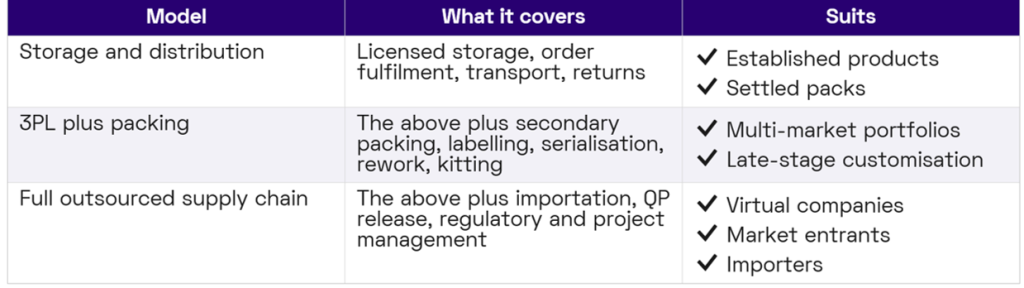
The middle and upper models are where most of the value sits. A provider combining packing and logistics on one site removes an inter-site handoff: no transfer of released stock between packer and distributor, no duplicated goods-in checks, no second set of transport records, no argument about who caused the damage. Central Pharma runs filling, secondary packing and licensed storage and distribution from one 267,000 sq ft site in Bedford.
What you give up
Control is the honest cost. You cannot walk onto the floor and reprioritise an order, you are one customer among many when capacity is tight, and service levels depend on what the contract says rather than on who you know.
Visibility is the second: without a decent system interface you telephone for stock figures instead of reading them. The third is the customer relationship, because if the provider despatches, its paperwork and delivery performance become your brand.
The regulatory reality
Outsourcing does not move responsibility. The marketing authorisation holder remains accountable for the product, and a company contracting out storage and distribution must satisfy itself that the provider is competent and compliant.
Three consequences follow. You need a written technical agreement defining who does what: storage conditions, temperature monitoring and excursion handling, deviations, complaints, recalls, returns, destruction, record retention and change control. You need to audit the provider before appointment and on a defined cycle afterwards, not simply read their certificates. And you need to hear about deviations and inspection findings affecting your product within a stated time.
GDP requires qualification of suppliers and customers in both directions, so expect a serious provider to qualify you as closely as you qualify them.
The commercial and contractual questions
Cost model. Most providers price on storage per pallet per week, goods-in per pallet, pick and pack per order and per line, transport by service, and value-add such as labelling or rework by time or unit. Model your real order profile against the rate card: a tariff that looks cheap on storage can be dear if you ship many small multi-line orders.
Liability for product loss. Standard haulage liability conditions are capped by weight and close to worthless for high-value medicines. Negotiate liability for loss, damage and temperature excursion explicitly, on product value, and check the insurance behind it.
KPIs and remedies. Define on-time despatch, order and line accuracy, stock accuracy, excursion rate and complaint response time, then define what happens when they are missed. KPIs without service credits or a right to remedy are decoration.
Data ownership. Your stock data, batch records and customer transaction history are yours. Confirm that in writing, with the format and timescale for return at exit.
Exit and transition. Notice period, transfer of stock and records, cooperation with an incoming provider, cost of exit. Negotiate this on the way in, while you still have bargaining power.
Red flags
- No named Responsible Person, or one spread across several unrelated sites.
- Temperature mapping that is years old or covers only part of the warehouse.
- Reluctance to share the last MHRA inspection outcome or to accept an audit.
- A technical agreement offered as a template, with no product-specific detail.
- Vague answers on recall timing, or on who actually carries your product once transport is subcontracted.
A short due diligence checklist
- Confirm the WDA(H), and the MIA where packing or QP release is involved, and that the licence covers your products and schedules.
- Audit on site: temperature mapping and monitoring, alarm response, security, quarantine, controlled drug storage, batch traceability.
- Run a recall simulation against a real batch number and time it.
- Model a year of your order profile against the rate card.
- Agree the technical agreement, KPIs, liability and exit terms before signature.
Key takeaways
- Outsourcing turns fixed warehousing and licensing cost into variable cost, and buys authorisations, qualified storage and QP capacity without building them.
- The marketing authorisation holder keeps regulatory responsibility, so a technical agreement and a real audit programme are mandatory.
- Choose the model deliberately: storage and distribution, 3PL plus packing, or full outsourced supply chain with importation and QP release.
- Liability for product loss, KPI remedies, data ownership and exit provisions are the terms most often left too loose.
- A provider that packs and distributes on one site removes an inter-site handoff and the traceability gap with it.
Talk to Central Pharma about outsourced pharmaceutical logistics
Central Pharma has been a contract filler, packer and specialised logistics provider since 2006, from a 267,000 sq ft Bedford site with more than 10,000 pallet locations, temperature-controlled warehousing, Schedule 1 to 5 controlled drug storage, and transport by in-house electric vehicles and approved vendors. As a site of importation and QP release with three Qualified Persons, MHRA MIA and WDA(H), FDA registration, ISO 9001 and ISO 13485, it supports product released to more than 60 countries. To discuss outsourcing, get in touch.
To stay informed on our latest thinking and technology developments, follow us on LinkedIn.
Contact Us Today View all news